Two machines can have similar nominal press force and still perform very differently on the same molded pulp product. Tonnage is only one part of the system: product geometry, projected pressing area, platen utilization, mold design, temperature uniformity, water removal, wet-preform transfer, and stable qualified output all affect the result.
The practical selection rule: start with the finished product, then define the mold and process, and only then select the machine.
This guide shows how to turn a product requirement into a wet press molded pulp machine specification without relying on nameplate figures alone.
In this guide, wet pressing and molded pulp thermoforming refer to a process in which a wet or partly dewatered pulp preform is transferred into matched heated molds. Heat, pressure, and controlled water or vapor removal work together to dry the part, densify the fiber structure, and set its final geometry.
A molded pulp thermoforming machine is a common related description, but suppliers do not always use these terms consistently. When reviewing molded fiber thermoforming equipment, ask two questions:
Wet pressing is commonly considered for electronics inserts, cosmetic and consumer packaging, premium egg cartons, tableware, and selected food packaging that require a refined surface, controlled dimensions, accurate nesting or closing, or a high-quality presentation. Research describes thermoforming as a route with strong potential for thin-walled, high-quality molded pulp products while also showing that pulp, mold temperature, and process conditions affect dewatering and dimensional accuracy (Didone and Tosello, 2019).
Wet pressing is not automatically the best choice for every product. Conventional forming followed by separate drying may be more economical for standard egg trays, protective inserts, and products with moderate appearance or tolerance requirements. If an already dried product mainly needs flattening, calibration, or surface improvement, a post-drying hot press machine may be the more appropriate route.
| Process route | Condition entering the relevant stage | Where drying occurs | Quality potential | Typical direction | Main trade-off |
|---|---|---|---|---|---|
| Wet press / thermoforming | Wet or partly dewatered preform | Mainly inside matched heated molds | Strong potential for smooth surfaces, density, and controlled geometry | Premium inserts, consumer packaging, tableware, selected food packaging | Greater tooling, heating, transfer, and process-control burden |
| Conventional formed-and-dried route | Wet formed product | In a separate dryer, drying line, or other drying stage | Suitable for many protective and standard molded pulp products | Egg trays, transport trays, protective packaging | Usually more economical when a premium finish is unnecessary |
| Post-drying hot press | Already dried molded pulp product | Drying is completed before pressing | Can improve flatness, shape, and surface calibration | Upgrading or calibrating conventionally dried products | Adds a finishing step and remains limited by the incoming dry part |
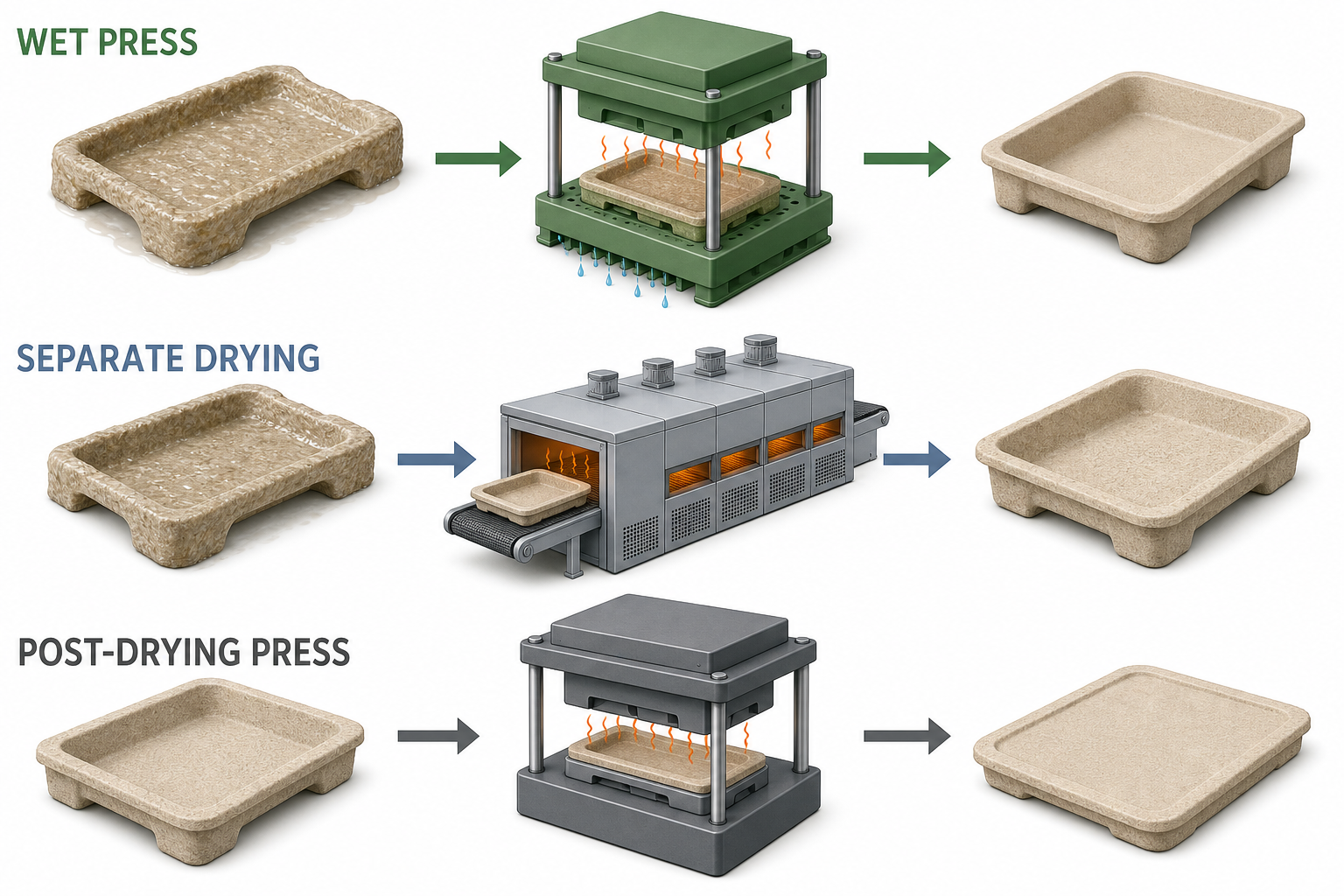
The term "dry press" is used inconsistently in the market. Map the actual production route instead of making a decision from the label alone. Buyers still comparing complete routes can first review the broader pulp molding machine category.
A useful specification begins with a drawing, sample, and measurable acceptance standard. Words such as "smooth," "premium," and "high precision" are not sufficient on their own.
| Finished-product requirement | Machine and mold implication |
|---|---|
| Overall size, projected area, and cavity count | Platen occupation, force demand, cavity pitch, heating zones, and transfer layout |
| Depth, ribs, sidewalls, radii, and draft | Daylight, stroke, wet-preform support, venting, release, and local-thinning risk |
| Target weight and thickness distribution | Forming consistency, drainage balance, pressure distribution, and thermal load |
| Flatness, dimensions, nesting, closing, or assembly fit | Mold stiffness, alignment, shrinkage compensation, trimming datum, and inspection method |
| Surface and visual standard | Pulp furnish, forming quality, mold-face condition, temperature uniformity, release, and handling |
| Printing, coating, or lamination | Validation with the intended ink, film, adhesive, surface treatment, and curing process |
| Food-contact or destination-market requirements | Raw-material control, contact surfaces, documentation, and project-specific testing |
A smoother wet-pressed surface can support later printing or lamination, but it does not guarantee adhesion or appearance. Test the complete downstream system on representative production parts. Edge quality also depends on product design, mold condition, release, and any required trimming process.
Nominal tonnage is a machine rating, not evidence that every cavity will receive the required and evenly distributed process load. Machine selection should account for total projected product area, cavity layout, material, geometry, and the pressure distribution demonstrated during trials.
Ask the supplier to show how the proposed force, platen, mold arrangement, and number of cavities were derived from your product. Adding cavities may increase theoretical output but can reduce quality or stability if load, heat, drainage, or transfer becomes uneven.
Wet pressing is a coupled heat-and-mass-transfer process. Mechanical compression and thermally assisted drying occur together, so force cannot be assessed separately from heat and the path used to remove water and vapor (Didone et al., 2020).
Stable production depends on:
Higher temperature or pressure is not automatically better. Studies show that heat input and pressing force can influence density, roughness, convertibility, and defect formation, but the effects depend on pulp furnish and test conditions (Niini et al., 2022; Pasquier, Skunde, and Ruwoldt, 2023). The operating window must therefore be established with the intended material, product, and mold.
Utility planning belongs in the same review. Confirm the proposed heating method, electrical load, vacuum, compressed air, cooling or water requirements, exhaust or vapor handling, and factory service capacity. Installed power alone does not predict energy use per qualified product.
Advertised dry-cycle or press-dwell time is not the same as saleable output. Use a transparent calculation:
Stable cycles per hour must include loading, transfer, closing, dwell, opening, release, demolding, and stacking. Qualified yield counts accepted products rather than every discharged part.
Shift or daily output must also allow for startup, heating, changeover, cleaning, maintenance, rejection, rework, and product stabilization. Trimming, inspection, stacking, or packing may become the actual bottleneck. Ask how a quoted capacity was measured and require sustained qualified-output evidence using a representative product.
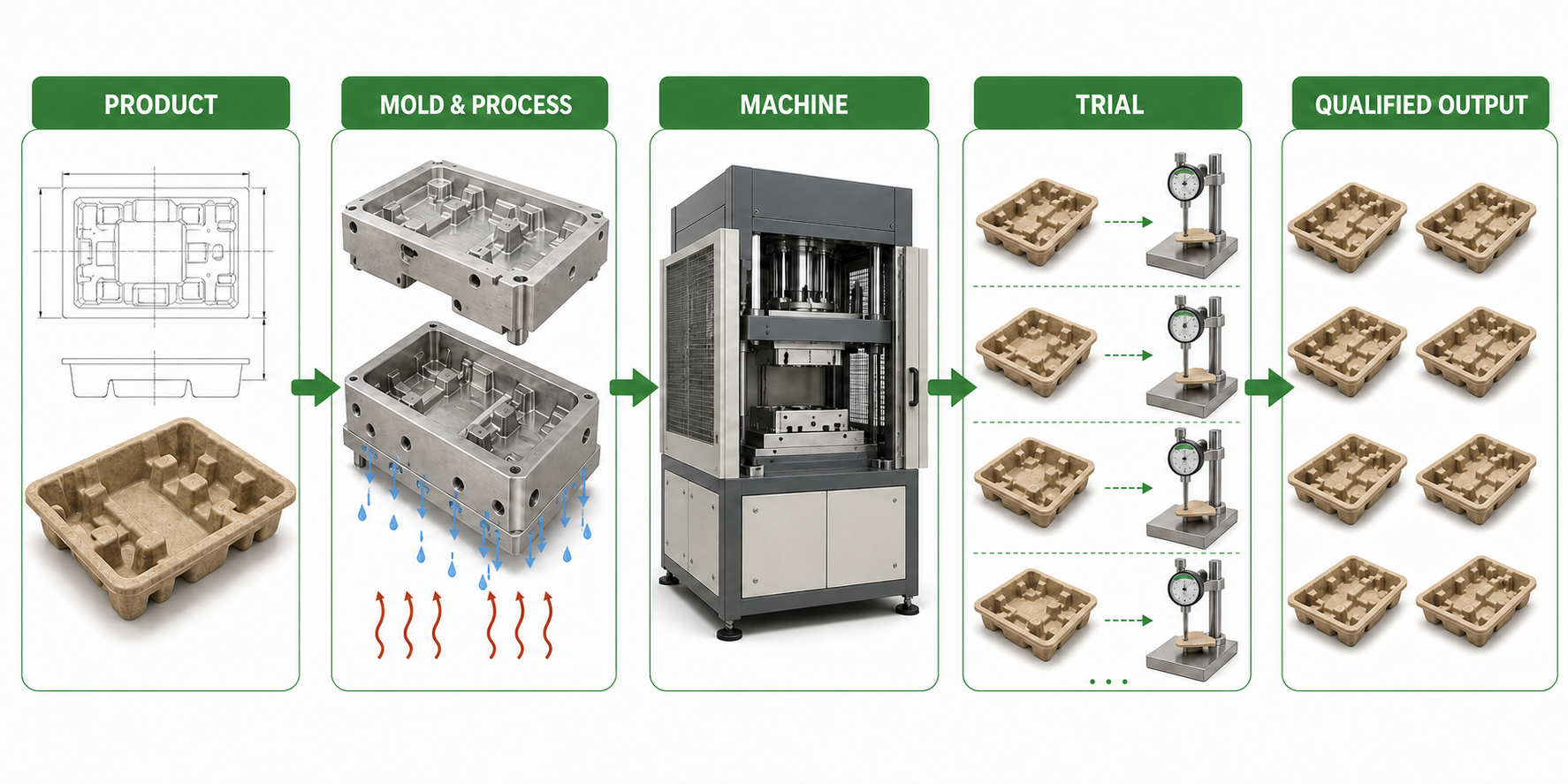
Automation should solve a defined production problem. A more automated machine is not automatically the better investment if the product, mold, or process window is still changing.
| Decision factor | Sampling or small-batch | Semi-automatic | Integrated automatic |
|---|---|---|---|
| Product maturity | Development, trials, or limited orders | Validated products with variable demand | Mature product with repeat demand |
| SKU and mold changes | Frequent experimental changes | Mixed SKUs and accessible changeovers | Longer production campaigns |
| Labor and handling | Hands-on observation and adjustment | More operator transfer and judgment | Reduced manual handling after validation |
| Wet-preform transfer | Easy to observe and refine | Depends on fixtures and operator method | Requires a proven automatic transfer path |
| Downstream operations | Usually separate | Flexible trimming, inspection, and stacking | Must be balanced with line output |
| Integration burden | Compact development focus | Moderate | Coordinated layout, utilities, controls, safety, and maintenance |
A thermoforming sampling and mold-testing plant may suit development, mold validation, or limited production. An integrated pulp thermal production line is more relevant when forming, transfer, wet pressing, and downstream handling must operate as one production system. The correct choice depends on product maturity, order pattern, labor, layout, utilities, and required qualified output.
The forming mold controls drainage, thickness distribution, and the geometry of the preform delivered to the heated press. The forming and hot-press molds must therefore share compatible cavity pitch, datums, transfer logic, and dimensional compensation.
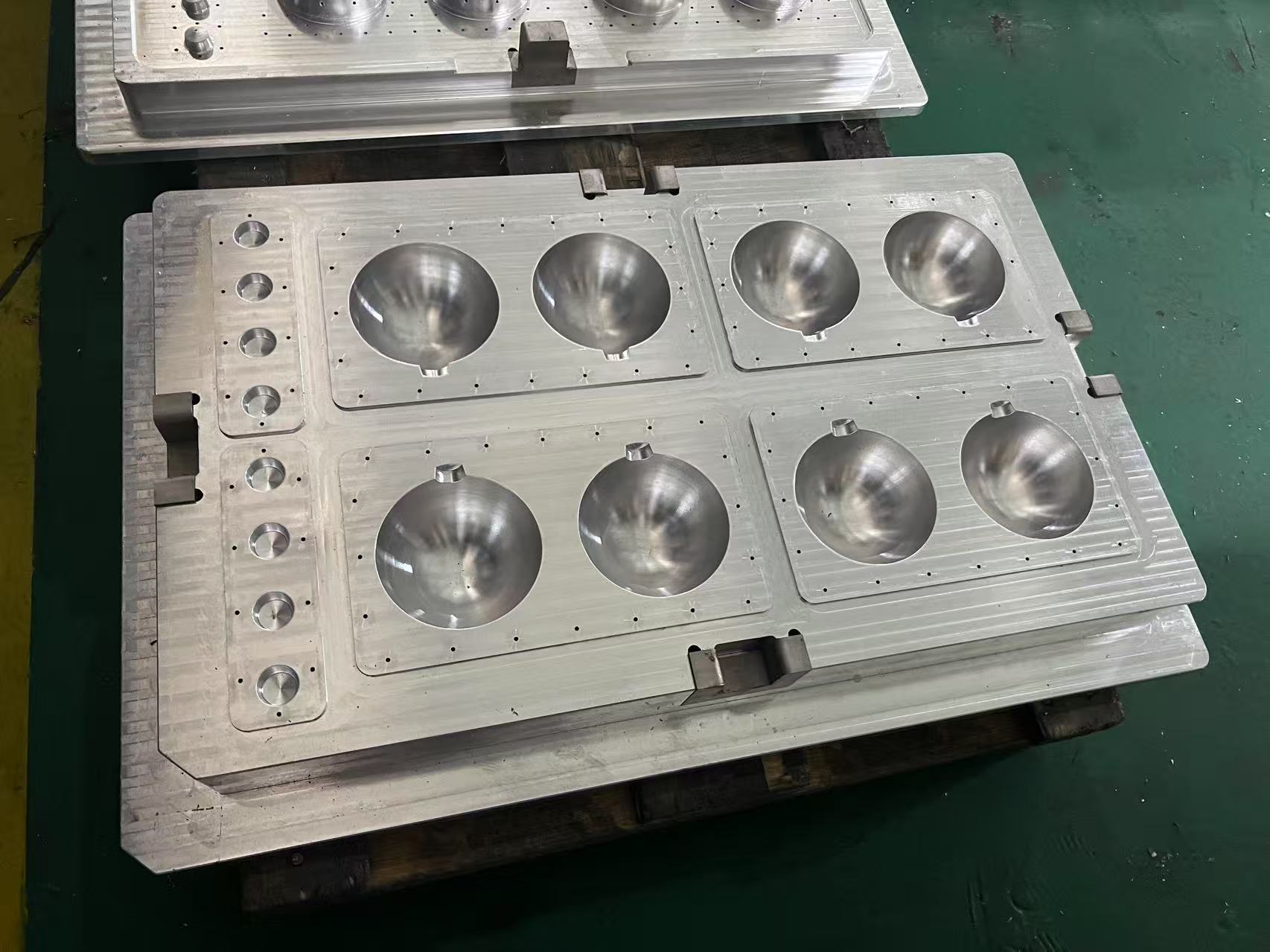
Machine and mold decisions should be made together. Printing, coating, trimming, laminating, inspection, stacking, labeling, and packing requirements should also be identified before the equipment configuration is frozen.
One attractive sample proves that a result was achieved once. It does not prove stable production. Agree on the test material, measurement method, sampling plan, and acceptance criteria before the trial.
Use representative pulp, additives, tooling, transfer, utilities, trimming, and downstream conditions. Record results by cavity when cavity-to-cavity variation matters. A trial should demonstrate the process window, not only the best sample.
Send the supplier enough information to review the complete product, mold, machine, and process system:
DWELLPAC can review the process route, mold and cavity logic, machine envelope, transfer method, utility interfaces, downstream requirements, and product-trial plan. Compatibility with an existing line requires complete mechanical, utility, and control-interface information. CE certification can be provided according to project requirements.
Send your product drawing or sample, material, quality requirements, target qualified output, existing equipment information, utilities, and destination market. DWELLPAC can review the process route before the machine configuration is finalized.
Contact DWELLPACA wet press receives a wet or partly dewatered preform and removes moisture while setting the geometry in heated matched molds. A post-drying hot press receives an already dried part and mainly reshapes, flattens, or calibrates it.
Common candidates include premium electronics and cosmetic inserts, presentation packaging, tableware, selected food packaging, and premium egg cartons that require refined surfaces, fine geometry, controlled thickness, or close fit. Product economics and trials still determine whether the route is appropriate.
Evaluate the total projected area, cavity count, pulp furnish, product geometry, usable load distribution, platen area, mold stiffness, and frame behavior together. Confirm the proposed selection through product and tooling trials rather than relying only on nominal tonnage.
No. Performance also depends on pulp, additives, forming quality, mold condition, residual moisture, dust, surface wetting, ink or adhesive chemistry, film, treatment, and curing. Test the intended downstream process on representative production parts.
Multiply cavities per cycle by stable cycles per hour and qualified yield. Then include startup, heating, changeover, cleaning, maintenance, rejects, rework, and downstream bottlenecks when estimating shift or daily output.
DWELLPAC can review compatibility using the product and mold data plus platen, mounting, daylight, stroke, transfer, heating, vacuum, drainage, utility, and control-interface information. Final suitability should be confirmed through engineering review and repeatable product trials.
Machine configuration, tooling, utilities, product quality, and capacity must be confirmed for the actual product, material, mold, and production conditions. Add a visible engineering-review credit only after the engineering team has completed that review.