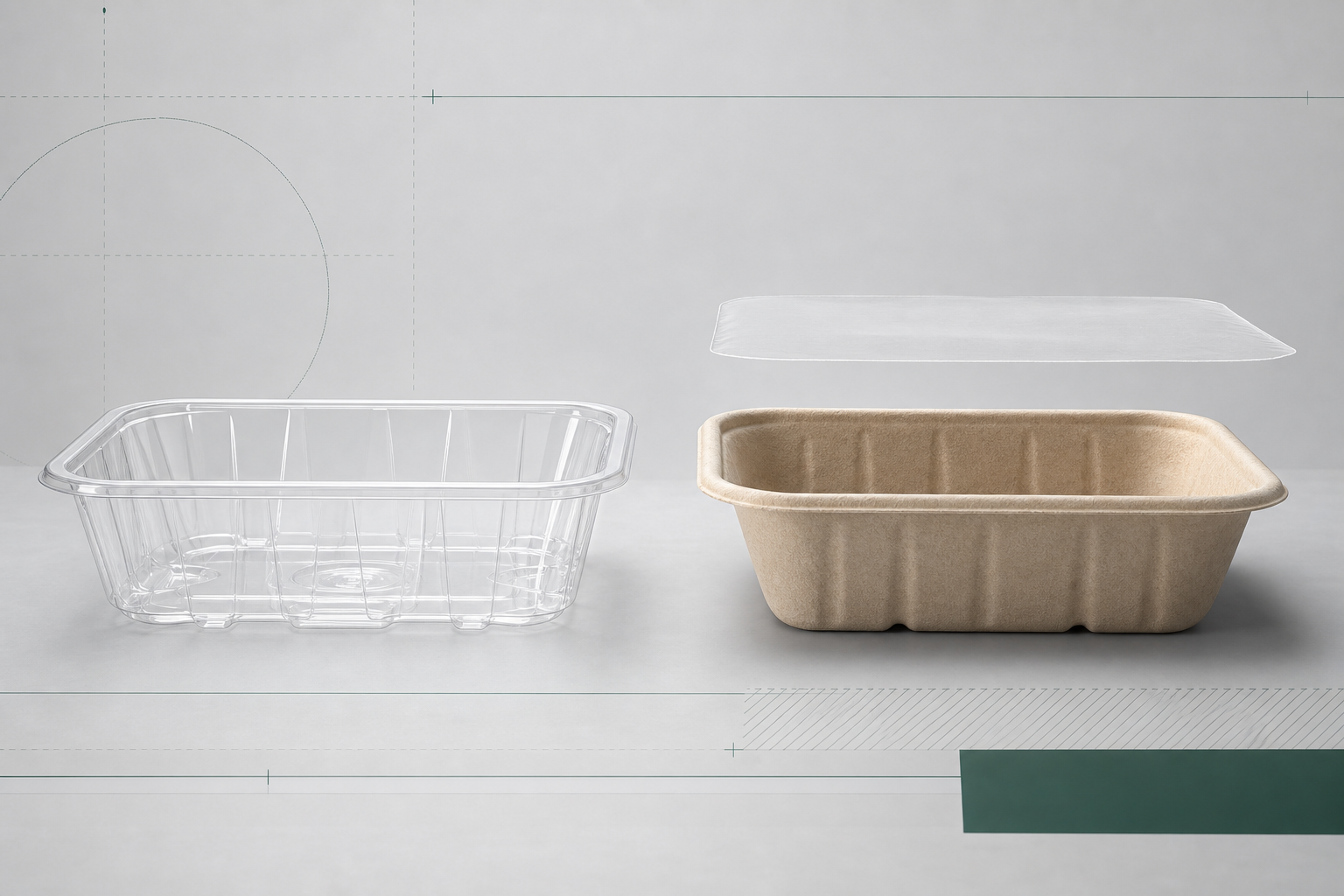
Yes, it can. When comparing molded fiber vs PET trays, replacing an all-PET tray with a molded fiber tray and a thin barrier film can substantially reduce the amount of plastic placed on the market. It may also reduce packaging Extended Producer Responsibility (EPR) fees.
The important limitation: the financial result is not a one-to-one conversion. It depends on how the finished package is classified, whether its materials are reported separately, the applicable fee categories, recyclability and eco-modulation rules, and the amount of waste created during production.
The right question is not only, "How much plastic did we remove?" It is: How will this packaging structure be reported, charged, recovered, and produced in each destination market?
From packaging concept to production
Reducing plastic mass is only the first decision. The proposed tray still has to run with repeatable film placement, heating, forming, edge trimming, stacking, and measurable yield.
For PLA/PBAT film projects, the DWELLPAC LZFM-ZDQB-110100 provides an automatic film-lamination route with integrated edge trimming. Suitability still depends on the actual film grade and thickness, tray geometry, barrier target, loading method, output requirement, and trimming method.
Consider an illustrative 20-gram food tray:
| Packaging structure | Fiber per tray | Plastic per tray | Total weight | Plastic at 1 million trays |
|---|---|---|---|---|
| All-PET tray | 0 g | 20 g | 20 g | 20,000 kg |
| Molded fiber tray plus thin film | 18.5 g | 1.5 g | 20 g | 1,500 kg |
That 92.5% figure is a material-mass calculation. It is not a claim that the EPR bill will also fall by 92.5%. The total package still weighs 20 grams. Depending on the program, the fiber portion may remain covered, the film may have a different rate from rigid PET, or the complete structure may need to be reported as a composite package.
Packaging EPR transfers part of the cost of collecting, sorting, and managing packaging waste to the producers defined by each program. Depending on the market and supply chain, the obligated producer may be a brand owner, importer, retailer, or another party.
The Circular Action Alliance Producer Resource Center explains that base fees vary by packaging type. Quantity, recycling-system cost, commodity revenue, and recycling performance can influence the rate, while eco-modulation may add incentives or disincentives.
The multiplication is easy. The difficult part is determining the reportable material and category.
The fiber weight uses the applicable fiber category and the film weight uses the applicable film category. Use this only when the program permits component-level reporting.
The complete fiber-film tray uses the composite category required by the program. It would be incorrect to calculate the obligation only on the film layer.
A dominant-material, separability, or other program-specific rule may apply. Material percentages alone cannot confirm the treatment.
Until the applicable Producer Responsibility Organization (PRO) or compliance adviser confirms the route, use the relevant scenarios to create a range. A range based on current categories is more useful than one precise but unsupported savings figure.
A molded fiber tray may require film to achieve the water, oil, sealing, hygiene, or shelf-life performance needed by the product. That performance must be validated with the actual tray, film, food, temperature, and process conditions.
PET film is not compostable. A molded fiber tray with PET film should not be described as plastic-free or compostable.
PLA and PBAT are also plastics. A PLA/PBAT film does not automatically make the complete package compostable. The specific film and finished package may require certification, correct labeling, and access to suitable collection and treatment infrastructure. Compostability and recyclability should not be treated as interchangeable claims.
The Oregon Department of Environmental Quality states that covered producers must register, report supply, and pay fees through an approved PRO. Fee charging began on July 1, 2025, and Oregon notes that fee rates change annually.
The Colorado Producer Responsibility Program requires participating producers of covered packaging and paper products to report and fund the statewide system. Circular Action Alliance states that Colorado fee obligations began in January 2026.
California SB 54 covers packaging and single-use plastic food service ware. Permanent regulations became effective on May 1, 2026. Circular Action Alliance lists California pre-program early fees in its August 2026 planning schedule, while its producer FAQ states that regular program fee obligations begin in January 2027. CalRecycle's producer guidance also addresses registration, reporting, and source-reduction requirements.
Timing matters: a chart showing a "2025 California EPR fee" is a planning illustration, not an actual California producer invoice.
Define food-contact, water, oil, sealing, temperature, shelf-life, and appearance requirements before selecting a film route.
Identify destination markets, the obligated producer, annual units, material weights, categories, rates, and eco-modulation rules.
Match recycling, industrial-composting, or other claims to evidence for the complete package and the available local system.
Include film trim, rejected trays, restart loss, and changeover waste in the business case rather than relying only on nominal film weight.
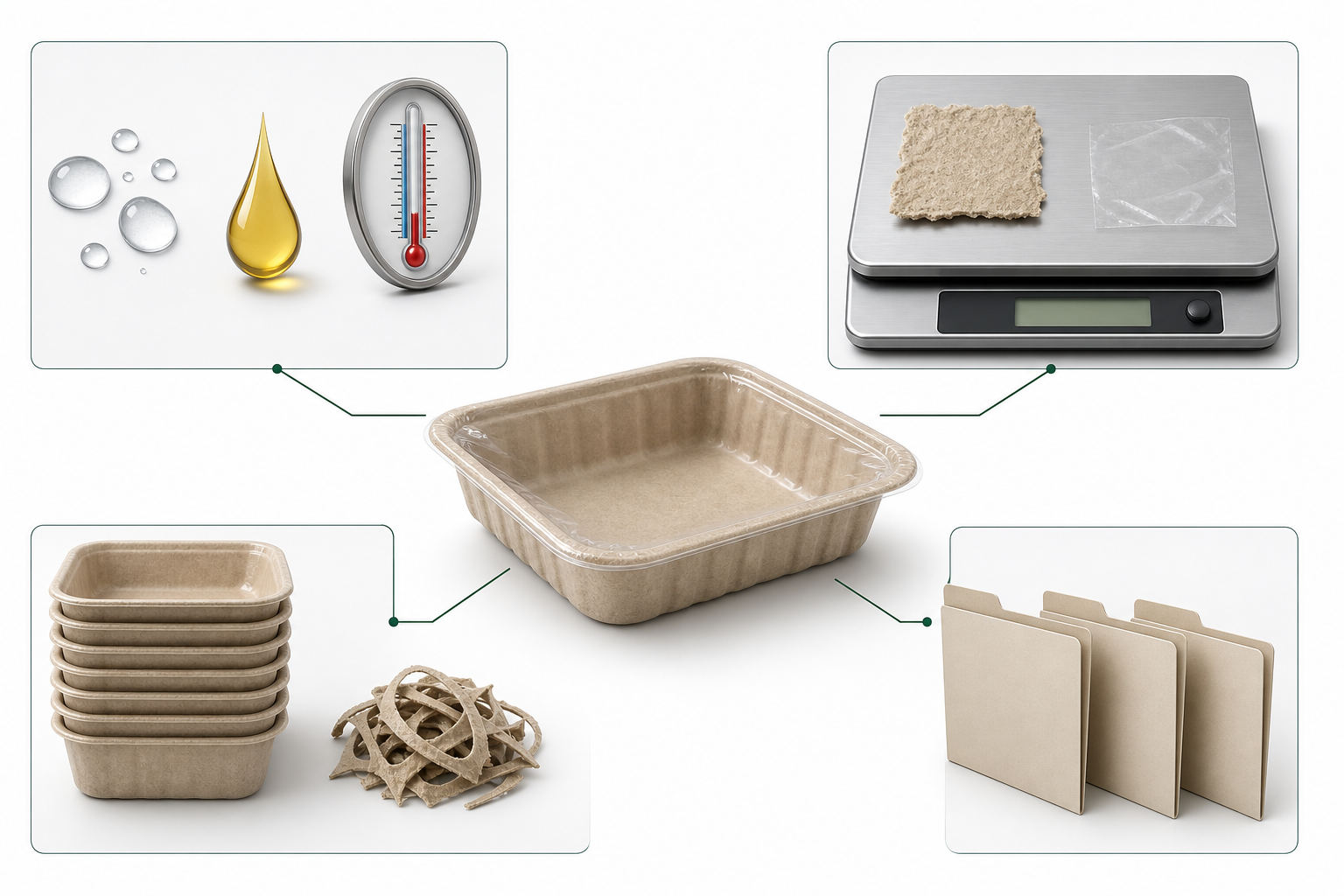
Film lamination is sensitive to both the molded fiber substrate and the film route. A structure that looks attractive in a spreadsheet can become expensive if the film wrinkles, the seal is incomplete, trimming produces excessive scrap, or the finished trays cannot stack consistently.
For a broader explanation of film materials, process stages, common defects, and equipment selection, read DWELLPAC's Film Laminating for Pulp Tableware: Process, Materials & Equipment Guide.
An EPR calculation can support a packaging decision, but the business case only becomes real when the selected structure can be produced at stable quality and measurable yield. The laminating machine does not determine the legal EPR category; its role is to turn the selected packaging structure into a repeatable production process.
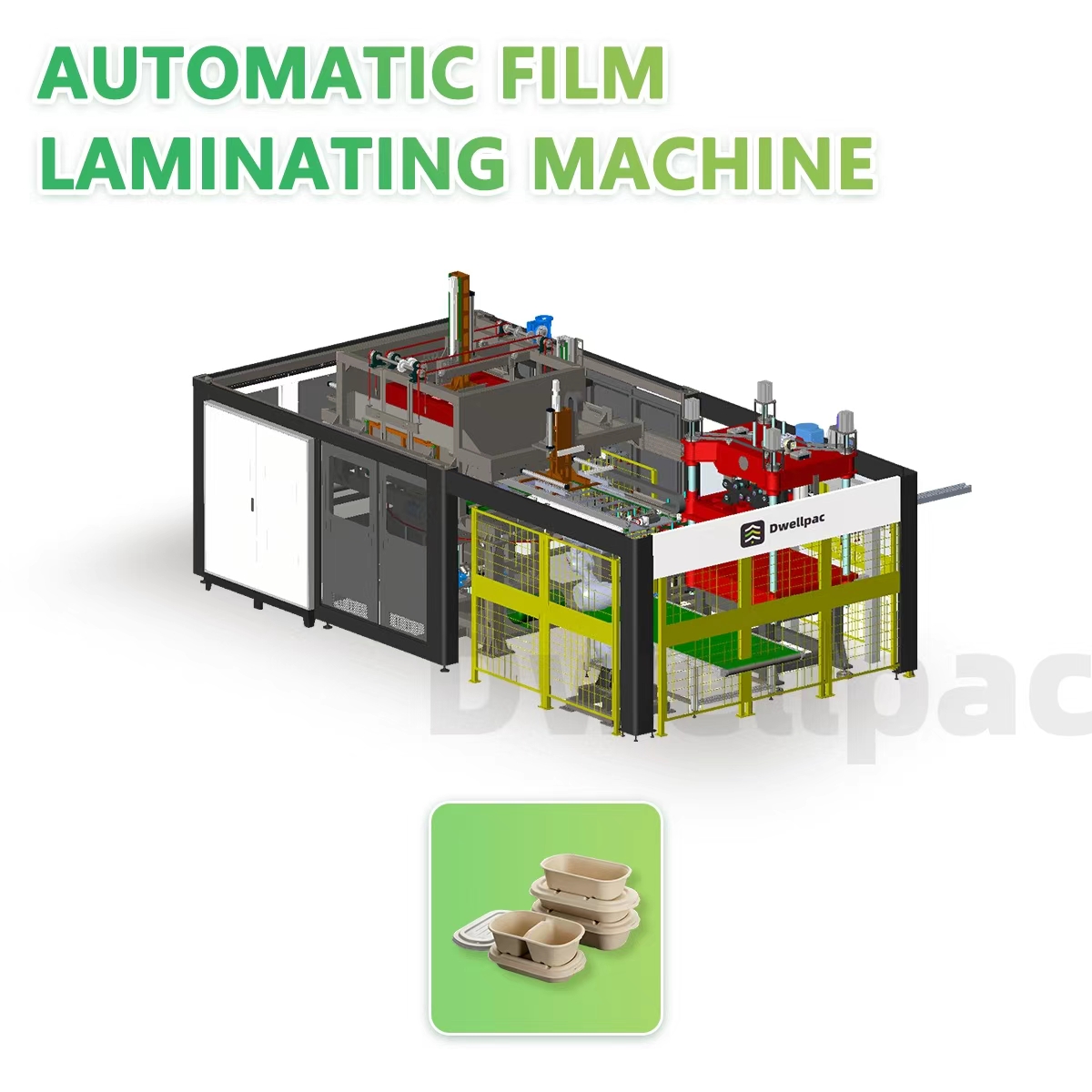
DWELLPAC LZFM-ZDQB-110100
PET-film compatibility is not currently confirmed and should not be assumed. Final configuration requires a project review using the customer's actual materials and product.
Replacing a 20-gram PET tray with 18.5 grams of molded fiber and 1.5 grams of film reduces plastic mass by 92.5% in this illustrative comparison. That can create a better EPR position, but only when the reporting category, end-of-life claim, and production process support the business case.
Before investing, answer three questions:
Send the tray drawing or sample, substrate weight, PLA/PBAT film grade and thickness, barrier and temperature requirements, target output, annual volume, destination market, loading method, and trimming requirement. DWELLPAC can review the lamination process and equipment direction. Final EPR classification and fees should be confirmed with the applicable PRO or compliance adviser.
No. Lower plastic mass can improve the result, but the final obligation depends on the reportable category, total covered weight, current rates, recyclability, eco-modulation, and other program charges.
Sometimes, but not by assumption. A program may require component-level reporting, a composite category, or another classification method. Confirm the actual construction with the applicable Producer Responsibility Organization before calculating savings.
Not automatically. PLA and PBAT are plastics. Compostability claims depend on the specific film and complete package, relevant certification, correct labeling, and access to suitable treatment infrastructure.
PET-film compatibility is not currently confirmed. The linked DWELLPAC film laminating machine is confirmed for PLA/PBAT applications. Any other film route requires separate technical validation and should not be assumed.
Film may be needed to provide water, oil, sealing, hygiene, or shelf-life performance. The design task is to meet that requirement with an appropriate material route while verifying the resulting recovery and EPR treatment.
Send the product drawing or sample, tray dimensions and weight, PLA/PBAT film grade and thickness, required barrier and temperature performance, target output, annual volume, loading method, trimming requirement, and destination market.
Method note: The 20-gram package structure is an illustrative comparison, not a customer result or state fee quotation. Policy timing and source pages were checked on July 23, 2026. DWELLPAC equipment statements are limited to the confirmed PLA/PBAT application scope.
This article provides packaging and production-planning information, not legal or compliance advice.