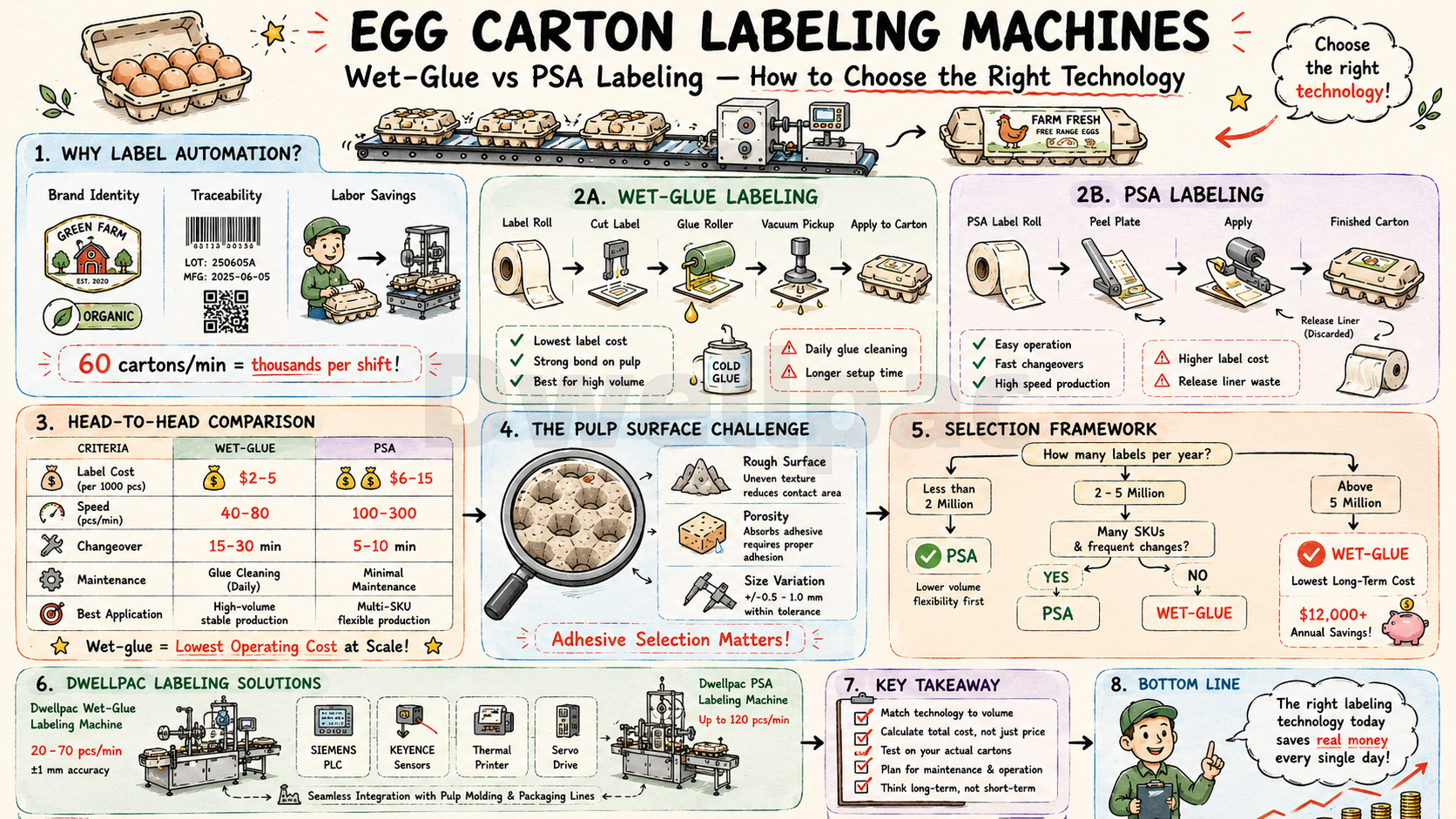
Quick answer: choose wet glue when production runs are long, label designs remain stable, and label-material cost is a priority. Choose PSA (self-adhesive) labeling when SKUs change frequently, labels arrive pre-printed, and fast changeover matters. The final choice should also account for glue consumption, cleaning, carton surface, label size, and required output.
Label prices above are DWELLPAC reference purchasing ranges as of July 2026, not fixed quotations. Wet-glue paper-label pricing excludes glue consumption. Final prices vary with label size, paper or facestock, printing, adhesive specification, order quantity, and supplier.
| Decision Factor | Wet Glue | PSA / Self-Adhesive |
|---|---|---|
| Reference label price | RMB 0.10–0.17/pc, plus glue | RMB 0.18–0.30/pc |
| Best fit | Long runs and stable label designs | Frequent SKU or artwork changes |
| Changeover | More setup and cleaning | Generally faster and simpler |
| Main operating consideration | Glue control, cleaning, and carton surface | Label-stock cost, liner handling, and adhesive match |
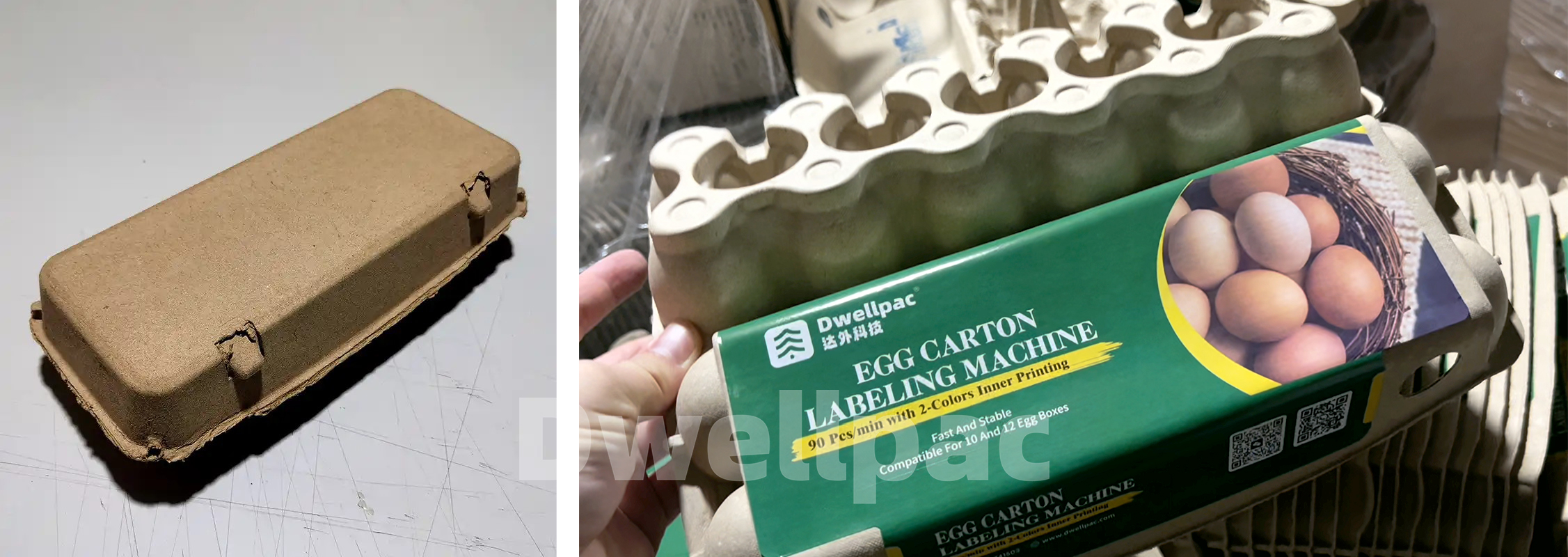
Egg cartons from molded pulp are inherently porous, textured, and dimensionally variable within ±0.5–1.0 mm. Unlike smooth plastic or coated paperboard, pulp surfaces demand specific adhesive strategies — and getting it wrong means flagging labels, adhesive bleed-through, or cartons that fail quality inspection on retail shelves.
Three forces are driving egg producers to invest in automated labeling:
Brand differentiation. A generic blank egg carton is a commodity. A printed, branded carton communicates farm identity, organic certification, free-range claims, and shelf appeal. In retail markets where eggs move from bulk trays to consumer-facing packs, the label is the product’s face.
Regulatory traceability. Markets in the EU, North America, and increasingly Southeast Asia require batch codes, production dates, and origin information on each consumer unit. Manual stamping or hand-labeling cannot scale past a few hundred cartons per day without errors — and a single mislabeled batch can trigger a costly recall.
Labor economics. A trained operator hand-labels roughly 200–300 cartons per hour. A servo-driven labeling machine achieves the same output in under 15 minutes — with placement accuracy no manual process can match.
The labeling machine market for carton packaging divides cleanly into two technology families. The choice between them is the single most consequential decision in specifying a labeling line — it locks in your per-label cost for the life of the equipment.

How it works. Labels arrive on a roll as plain paper stock — no coating, no adhesive, typically 70–100 g/m² paper. The machine performs three sequential operations in precise coordination:
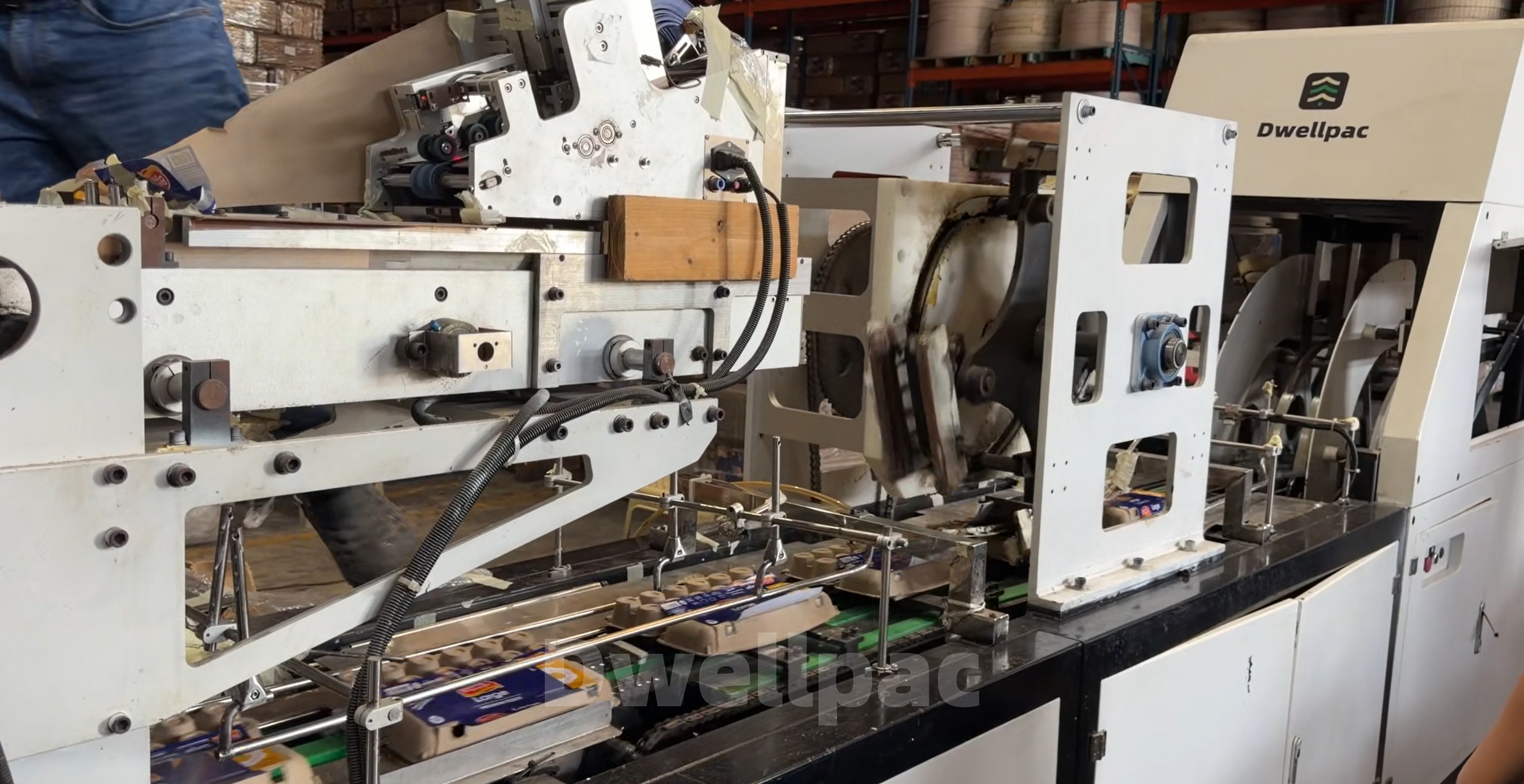
| Subsystem | Function | Critical Parameter |
|---|---|---|
| Label unwind & feed | Hold label roll, maintain web tension, advance labels | Web tension: 2–5 N; mis-feed rate < 0.1% |
| Registration sensor | Detect label position via printed registration mark | Response time < 1 ms; contrast sensitivity |
| Cutting unit | Sever individual labels from web | Blade life: 500K–1M cuts; cut accuracy ±0.3 mm |
| Glue system | Apply adhesive film to label back | Glue film: 30–50 μm; viscosity: 2,000–5,000 mPa·s |
| Pickup drum / arm | Transfer glued label to carton | Vacuum hold: −0.4 to −0.6 bar |
| Pressure station | Press label onto carton surface | Roller durometer: 40–60 Shore A; pressure 2–5 N/cm² |
Production capacity range:
How it works. Labels arrive pre-coated with pressure-sensitive adhesive on a silicone-coated release liner. The machine is mechanically simpler — no glue system, no cutter, just peel, place, and rewind.
| Subsystem | Function | Critical Parameter |
|---|---|---|
| Label unwind | Hold PSA label roll, control tension | Tension: 1–3 N; brake responsiveness |
| Peel plate | Separate label from liner | Plate edge radius: 0.1–0.3 mm; angle: 15–30° |
| Label sensor | Detect label edge for placement timing | Fork sensor or fiber optic; response < 0.5 ms |
| Pressure roller | Apply label to carton | 40–50 Shore A; free-rolling or driven |
| Liner rewinder | Collect spent release liner | Torque-controlled; auto-stop on break |
Production capacity range:
| Dimension | Wet-Glue (Cold Glue) | Pressure-Sensitive (PSA) |
|---|---|---|
| Reference label price | RMB 0.10–0.17/pc, plus glue | RMB 0.18–0.30/pc |
| Machine complexity | High: cut + glue + place, 3-axis coordination | Low: peel + place, single motion axis |
| Typical throughput | 40–80 pcs/min (mid-range) | 100–300 pcs/min (mid-range) |
| Placement accuracy | ±1.0 mm (servo-driven) | ±0.5–1.0 mm |
| Changeover time | 15–30 min | 5–10 min |
| Daily maintenance | Glue system flush + roller cleaning | Sensor check + liner reel change |
| Label material options | Plain paper, limited coated grades | Paper, film, metallized, clear |
| Sensitivity to ambient temp | High (glue viscosity shifts) | Low |
| Waste stream | Minimal (label offcuts only) | Release liner (≈ label area equivalent) |
| Best for | Stable, high-volume single-SKU production | Multi-SKU, flexible production; ultra-high-speed lines |
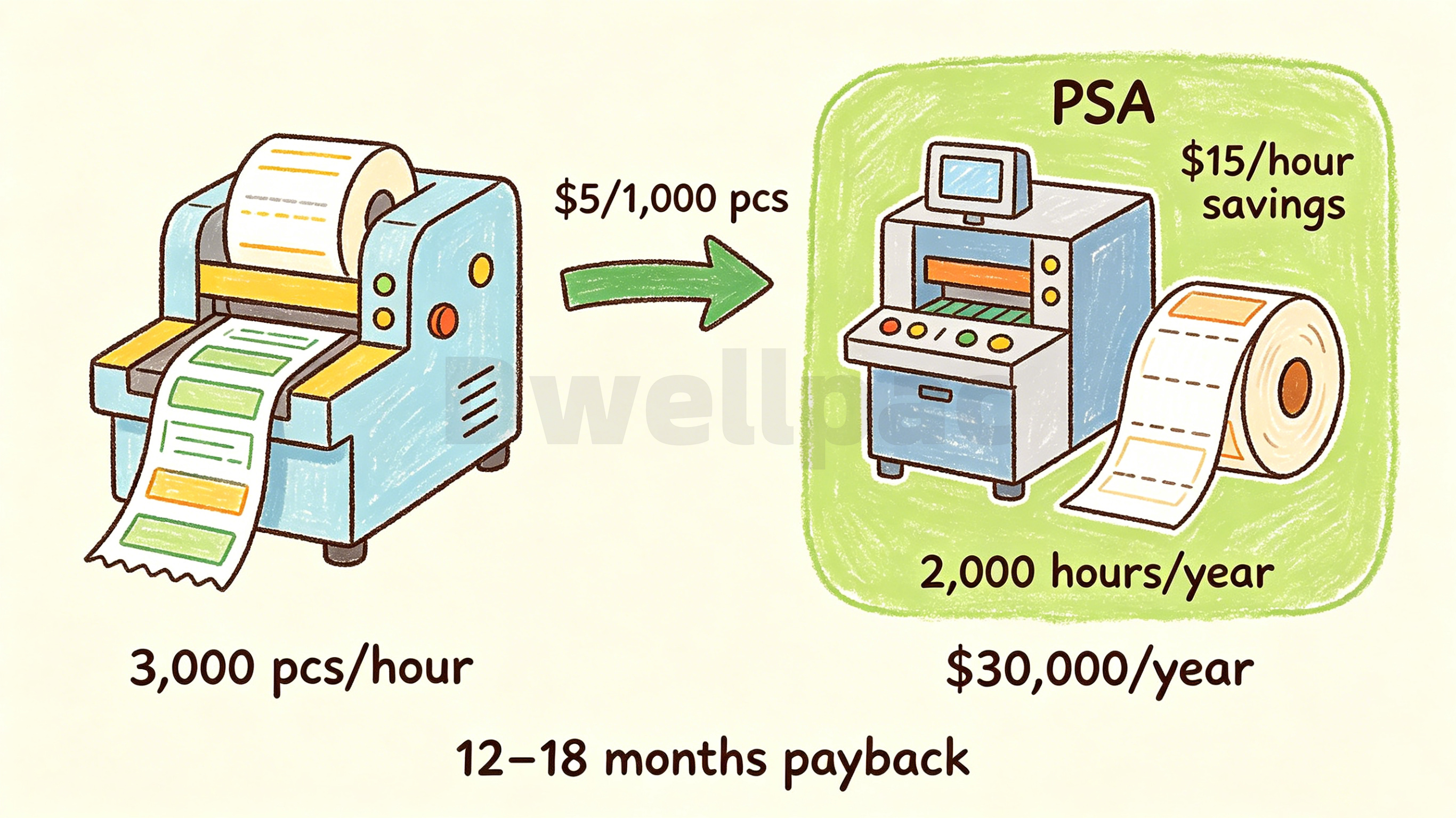
Calculate the crossover with your own quotations. Annual label-material difference = annual label volume × (PSA unit price − wet-glue paper-label unit price). Then add wet-glue adhesive, cleaning, maintenance, and changeover costs; for PSA, include liner handling and disposal. This produces a project-specific comparison without implying a fixed payback period.
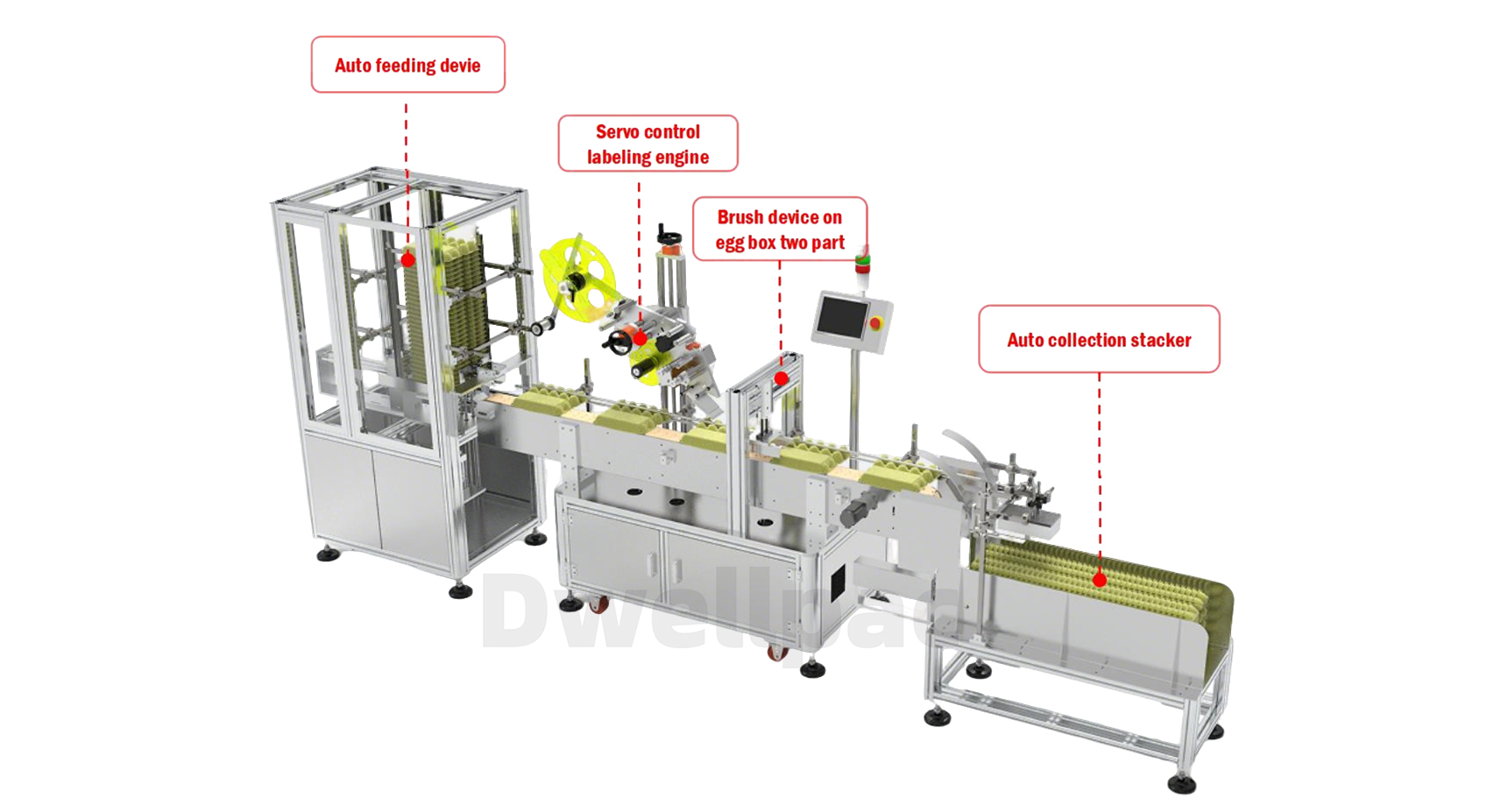
Understanding the physical layout of a labeling machine helps evaluate build quality, maintenance access, and integration into an existing pulp molding production line.
Stacked egg cartons are loaded into a vertical magazine or inclined feed table. A reciprocating pusher or rotary screw separator extracts one carton at a time. Feed guides must be stainless steel or hard-anodized aluminum to resist abrasive wear from pulp edges. Photoelectric sensors at the separator exit confirm successful singulation.
A flat-belt conveyor transports cartons through the labeling zone. At 60 pcs/min with 200 mm carton pitch, belt speed is 12 m/min. A trigger photoelectric sensor 50–100 mm before the label application point initiates the placement cycle. A rotary encoder provides real-time position data to the servo controller.
The label roll (inner diameter 76 mm, outer diameter up to 350 mm) is mounted on an unwind mandrel with adjustable friction brake or servo-controlled tension. A quick-release pneumatic mandrel reduces roll changes to under 2 minutes. Edge-guide sensors keep the label web centered.
The label web enters a rotary or guillotine cutter. After cutting, the detached label is held on a vacuum drum that rotates it past a glue application roller. Glue system variants: Roller system (simple, single pattern) or Nozzle system (precision, 30–50% less glue, partial-coverage patterns).
| Defect | Likely Cause |
|---|---|
| Label flagging (edge lifting) | Insufficient glue coverage; glue too viscous |
| Glue squeeze-out | Excessive glue film; carton over-compressed |
| Misplaced label | Registration sensor drift; cutter timing off |
| Wrinkled label | Uneven glue distribution; vacuum drum vacuum loss |
| Missing label | Cutter jam; label web break; glue nozzle clog |
The label web passes over a peel plate at an acute angle. The plate’s sharp edge — 0.1–0.3 mm radius, hardened tool steel or ceramic-coated — forces the label to separate from the liner. The take-up reel must maintain consistent tension; a slipping rewind causes slack that can wrap around the peel plate.
For pulp molded cartons, application pressure must be 3–8 N/cm² — higher than for smooth surfaces — to drive the label into the textured pulp. A compliant roller (40–50 Shore A silicone or EPDM) conforms to the carton texture. For wet-glue, 0.5–1.5 seconds dwell under pressure improves bond strength.
Labeled cartons are collected by a drop-stacker or pneumatic arm that builds neat stacks. A counter tracks production volume; a reject gate diverts failed cartons.
Standard labeling machines are designed for smooth, non-porous substrates — glass bottles, plastic containers, coated paperboard. Pulp molded egg cartons present three challenges those substrates never create:
Surface roughness. Molded pulp has a typical Ra of 5–15 μm, compared to under 1 μm for coated paperboard and under 0.1 μm for glass. The adhesive must penetrate the surface texture for mechanical interlock.
Porosity. Pulp absorbs moisture from wet glue — good for rapid initial tack through capillary action, but a risk if over-penetration leaves insufficient glue at the surface. PSA labels face the opposite problem: the porous surface reduces effective contact area, weakening the bond.
Dimensional variability. Post-molding shrinkage and warpage mean no two cartons are identical. Labeling machines must accommodate ±1 mm variation without losing accuracy.
For wet-glue: use glue with viscosity 3,000–4,000 mPa·s and solids content ≥ 55%. Lower-solids glues soak into the pulp too quickly, starving the bond line. For PSA: specify high-tack adhesive with initial loop tack ≥ 15 N/25mm. Office-grade adhesives fail on porous pulp within hours. Always test on production cartons, not lab samples — cartons from a cold mold behave differently from those at thermal equilibrium.
Use this four-step framework to determine which labeling technology — and which machine class — fits your operation.
| Cost Category | Wet Glue | PSA / Self-Adhesive |
|---|---|---|
| Label material | Annual volume × RMB 0.10–0.17 | Annual volume × RMB 0.18–0.30 |
| Adhesive | Add glue quote based on label area and coverage | Included in self-adhesive label stock |
| Machine investment | Use the confirmed project quotation | Use the confirmed project quotation |
| Routine work | Cleaning, glue control, and wear parts | Roll changes, sensors, and wear parts |
| Waste handling | Label trim and glue-related waste | Release-liner handling and disposal |
| Decision output | Compare annual total cost together with changeover time, quality stability, and required output. | |
The two label ranges are reference purchasing estimates, not guarantees. Use the same label dimensions, print coverage, material grade, adhesive requirement, order quantity, and delivery terms when comparing supplier quotations.
| Production Pattern | SKU Changes | Operating Priority | Likely Starting Point |
|---|---|---|---|
| Long, repeat production runs | Low | Lower label-material cost | Wet glue |
| Short runs across many products | High | Fast label changeover | PSA |
| Stable cartons but variable climate | Low | Cost plus process control | Wet glue after glue-system review |
| Uncertain future mix | Medium to high | Flexibility | PSA or a sample-based comparison |
A note on our approach. Dwellpac’s engineering core is in wet-glue labeling — for the majority of medium-to-large egg carton producers, the label-stock economics of cold-glue technology deliver the best long-term value. That said, the decision matrix above exists for a reason: not every operation fits the wet-glue profile today. We also supply PSA labeling machines for buyers whose volume, SKU variety, or maintenance constraints make PSA the pragmatic choice. Our goal is to help you land on the correct technology — whether or not the machine has our nameplate.
| Parameter | Specification |
|---|---|
| Capacity | Up to 60 pcs/min (3,600 pcs/h) in a suitable one-label configuration. Final output depends on carton format, label size and position, optional printing, feeding, and stacking requirements. |
| Placement accuracy | ±1.0 mm |
| Label size range | Width 40–200 mm; length 30–250 mm |
| Glue system | Nozzle-type, adjustable coverage pattern, built-in temperature compensation |
| Servo motor | Panasonic A6 series |
| PLC | SIEMENS S7-1200 |
| Sensors | KEYENCE photoelectric + fiber optic |
| Frame material | 304 stainless steel + powder-coated mild steel |
| Power | 220V / 50Hz single-phase; 1.5 kW |
| Best-fit production pattern | Stable label designs and long production runs where label-material cost is important |
| Parameter | Specification |
|---|---|
| Capacity | Up to 120 pcs/min (7,200 pcs/h) |
| Placement accuracy | ±1.0 mm |
| Label size range | Width 20–200 mm; length 20–300 mm |
| PLC | SIEMENS S7-1200 |
| Sensors | KEYENCE fiber optic |
| Ideal for | Multi-SKU operations, frequent artwork changes, or buyers prioritizing easier label changeover |
Review the wet glue egg carton printing and labeling machine or the egg carton sticker labeling machine for route-specific details. For integration with an existing pulp molding line, contact our engineering team.
Can I use PSA labels on a wet-glue machine, or vice versa?
No. The two technologies require fundamentally different machine architectures. A wet-glue machine has a glue system and cutter that a PSA machine lacks; a PSA machine has a peel plate and liner rewinder that a wet-glue machine does not need. Retrofitting one into the other is not practical.
What label material works best on pulp molded egg cartons?
For wet-glue: 70–90 g/m² uncoated or single-side coated paper. Heavier paper may flag at edges. For PSA: matte paper facestock with aggressive permanent acrylic adhesive. Avoid economy office-grade adhesives — they lack the initial tack needed for porous pulp.
How do I test if my carton surface is too rough for reliable labeling?
Tape test: apply a sample label, wait 60 seconds, peel back at 90°. If more than 20% of the label area shows adhesive failure, the surface needs treatment. Increase glue coverage for wet-glue, or specify higher-coat-weight PSA adhesive.
How often does the glue system need cleaning on a wet-glue machine?
Daily. Flush glue lines and rollers with warm water (40–50°C) at end of each shift. For 24/7 production, schedule a 15-minute cleaning every 8–12 hours. Dried residue causes uneven application, flagging, and mechanical binding.
What is the typical lifespan of a labeling machine?
There is no reliable universal service-life figure. It depends on shift pattern, operating speed, factory conditions, cleaning, preventive maintenance, and replacement of wear parts. Ask the supplier for a component-specific maintenance and spare-parts plan for the proposed configuration.
How much does an egg carton labeling machine cost?
Pricing depends on the labeling route, carton and label sizes, label positions, printing options, target speed, feeding and stacking method, and line integration. Send carton samples or drawings, label artwork, annual volume, and required output to request a project quotation.
If the decision matrix points to wet glue — or if you are still weighing the trade-offs — send your annual volume, carton dimensions, carton samples or drawings, label artwork, and target output. Our engineering team will use them to review the labeling route and prepare a project-specific configuration.
Request a Labeling Line Assessment Compare labeling machine routes →


