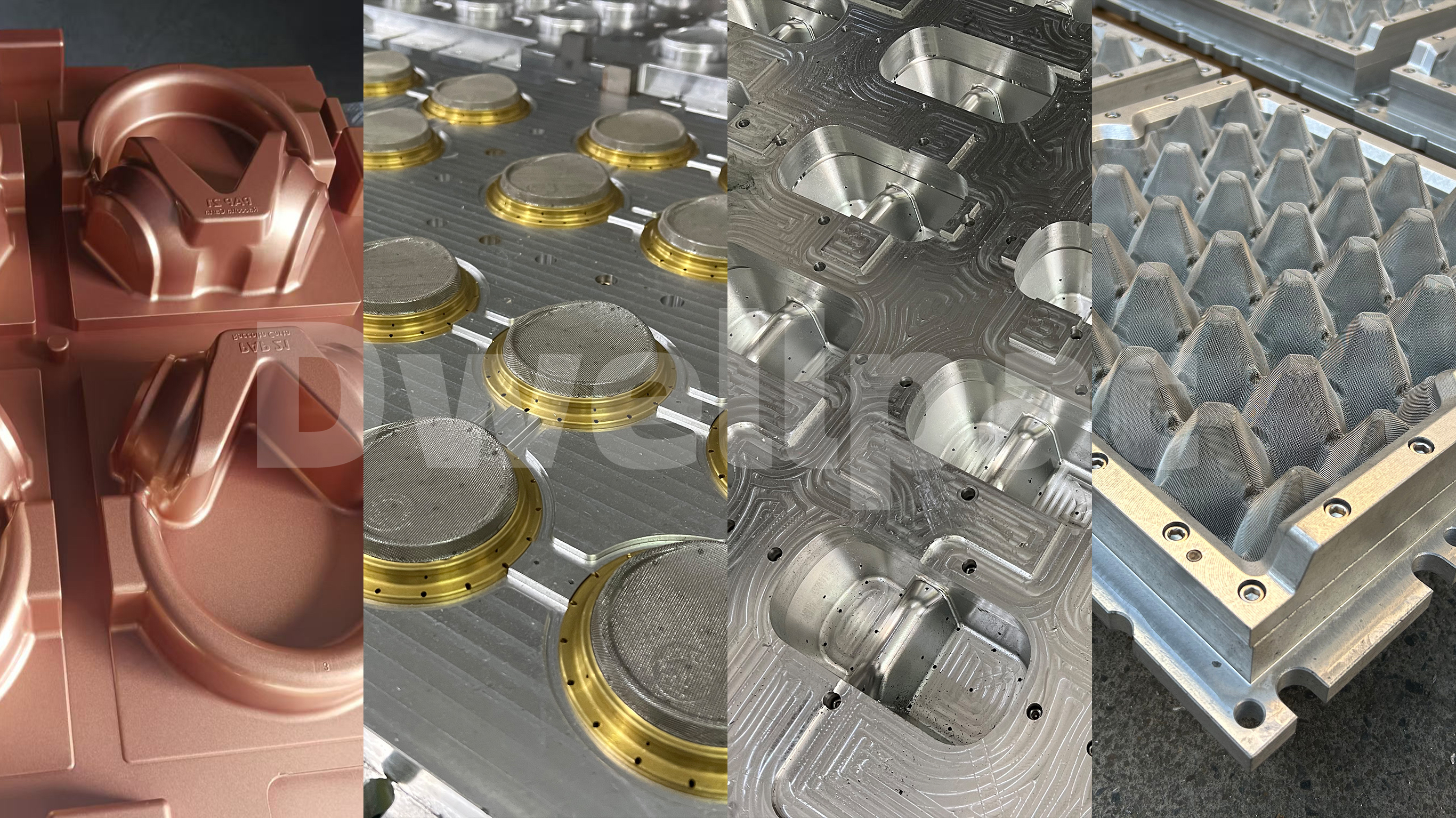
Mr. Chen, a purchasing manager at a mid-sized egg tray factory, receives two quotes for the same 30-cell forming mold:
| Supplier A | Supplier B | |
|---|---|---|
| Price | $7,000 | $12,000 |
| Lead time | 15 days | 30 days |
Chen goes with the cheaper option, saving $5,000 upfront. Eighteen months later, the base plate has warped, vacuum suction is uneven, and the defect rate has spiked to 8%. He replaces the mold for $11,000. Add in scrap losses and downtime — two-year total: $23,400.
Supplier B's mold is still running strong after six years. Two-year total: $14,800.
Key insight: That $7,000 mold actually cost 58% more. The single most underestimated cost in pulp molding production is the mold's Total Cost of Ownership (TCO).
Egg tray production uses two core molds: the forming mold (room-temperature vacuum forming) and the hot-press mold (100–200°C drying and pressing). This section covers the forming mold — the one where price differences most often deceive buyers.
A forming mold that's 40% cheaper cuts corners in four places. Every dollar saved upfront compounds into multiple dollars of downstream cost.
| Factor | Cheap Approach | Quality Approach |
|---|---|---|
| Base plate | Cast aluminum (recycled pour) | 6061-T6 billet plate |
| Internal structure | Porosity, uneven density | Uniform density, fine grain |
| Long-term stability | Gradual deformation under vacuum cycles | Stable billet structure, fatigue-resistant |
| Lifespan impact | Warped base → lost mold alignment → batch scrap | 2–3× service life |
This isn't the incremental gap between 6061 and 7075 — it's a fundamental quality chasm between cast and billet aluminum. Cast aluminum traps gas and impurities during pouring, creating internal porosity. The forming mold operates at room temperature — it doesn't need heat resistance. But it endures thousands of vacuum suction cycles per day. Under repeated mechanical stress, those pores and voids grow. The base plate loses flatness. Once the upper and lower mold halves no longer align, the entire mold is scrap. For a deeper dive on how 6061 and 7075 compare in hot-press mold applications, see our pulp mold materials selection guide.

The heart of any egg tray forming mold is the lamella system — the mold surface divided into individual strips, with vacuum gaps between them. Lamellas come in two materials:
| Factor | Cheap Approach | Quality Approach |
|---|---|---|
| Strip count | Fewer strips → saves machining / mold cost | Proper strip count for product curvature (e.g. 14 small vs. 8 large) |
| Strip mounting | Bolts from top → hard to access for repair; welding required for aluminum | Bolts from sides, cased in bottom frame → easy unclamp & replace |
| Mesh pressing | Rough manual wrapping, poor mesh-to-strip fit | Dedicated metal press tooling for each strip profile |

Mesh pressing is the process of bonding stainless steel wire mesh to each lamella strip using dedicated metal press tooling. Cheap molds skip the press tooling and rely on manual wrapping — human hands can't achieve the uniform pressure of a press die. The result: gaps between mesh and strip, uneven vacuum suction, and inconsistent product thickness. Press tooling may add $500–$1,000 per mold, but the scrap and labor it prevents pay for itself many times over.
Key insight: Regardless of material, more strips = better contour conformity = more uniform vacuum distribution. Cheap molds reduce strip count to save on machining or injection mold costs — the trade-off is uneven product surface and thickness variation.
| Factor | Cheap Approach | Quality Approach |
|---|---|---|
| Method | Worker drills holes by eye, freehand | Injection mold pre-marks hole positions → drill press |
| Hole distribution | Random → uneven vacuum → thickness variation | Uniform → stable vacuum → consistent product |
| Labor cost | Low (but high downstream scrap) | Higher once, lower forever |

Quality molds bake hole positioning into the injection mold design itself — the drill points are marked during molding, then precisely executed on a drill press. Cheap molds skip this step. A worker drills freehand. Hole positions deviate by ±1 mm or more. When dozens of holes accumulate these errors, local pulp pickup can vary by over 10%.
| Factor | Cheap Approach | Quality Approach |
|---|---|---|
| Process | Drawing approved → straight to production | Sample → test → adjust → confirm → produce |
| Risk | Dimensional errors discovered at customer site | All issues caught and fixed during sampling |
| Correction cost | Return / claim / remake (mold cost × N) | Time and materials during sampling only |
A sample mold typically costs 15–25% of the production mold price. Skip it, and a dimensional deviation discovered at the customer's floor means remaking the mold, two-way freight, and late-delivery penalties — far exceeding that 15–25%. The bigger loss: customer trust.
TCO = Purchase Price + Maintenance + Downtime Loss + Scrap Loss + Replacement Cycle Amortization

| Cost Component | How to Calculate | Most Overlooked? |
|---|---|---|
| Purchase price | Supplier quote + freight + duties | — |
| Maintenance | Labor + materials per repair, annualized | ✓ |
| Downtime loss | Lost capacity + idle labor + late-delivery penalties | ✓✓ |
| Scrap loss | Defective units × (material + labor + energy) | ✓✓✓ |
| Replacement cycle | Purchase price ÷ service life (years) | ✓ |
Scrap loss is the most overlooked — and the largest — component of mold TCO.
After the forming mold, the wet pulp blank enters the hot-press mold — the second core mold on an egg tray line. The hot-press mold cycles between 100–200°C, hundreds of times a day. This is where material choice becomes a cost lever of enormous consequence.
| Property | 6061-T6 Billet | 7075-T6 Billet |
|---|---|---|
| Tensile strength (MPa) | 310 | 570 |
| Yield strength (MPa) | 276 | 505 |
| Hardness (HB) | 95 | 150 |
| Thermal expansion (µm/m·°C) | 23.6 | 23.4 |
| High-temp fatigue life (thermal cycles*) | 15,000–25,000 | 40,000+ |
*Estimated for hot-press mold conditions: 100–200°C repeated heating and cooling. Actual life depends on operating temperature, mold design, and maintenance practices.
At 300 cycles per day, 6061 hot-press molds begin showing thermal fatigue deformation at 18–24 months. 7075, with nearly double the tensile strength and a finer grain structure, exceeds 40,000 thermal cycles — over six years of stable operation.

A pulp molding factory upgraded its egg tray hot-press molds from 6061 to 7075 billet aluminum:
| Metric | Before (6061) | After (7075) | Change |
|---|---|---|---|
| Mold purchase price | $10,500 | $13,200 | +26% |
| Annual maintenance | $1,800 | $600 | −67% |
| Product defect rate | 5.3% | 1.8% | −66% |
| Expected service life | ~18 months | 6+ years | +300% |
| Annualized total cost | $10,400 | $7,500 | −28% |
The mold cost $2,700 more upfront. But with dramatically lower scrap, reduced maintenance, and triple the lifespan, the factory saved $2,900 per year.
Dwellpac Engineering: Our mold team also applies GSM (grammage) optimization — reducing egg tray weight by 8–15% while maintaining full product strength. Same raw material input produces more units, further lowering per-unit cost.
The 7075 upgrade is just one part of a comprehensive hot-press mold strategy. See our egg carton mold specifications for Dwellpac's full mold engineering capabilities and case photos.
Assume an egg tray line producing 100,000 units/day at $0.008 material cost per unit. Defect rate gap of 3.5pp (5.3% vs. 1.8%), 300 production days/year:
Annual extra scrap = 100,000 × 3.5% × 300 = 1,050,000 defective units
| Cost Component | Per-Unit Cost | Annual Extra Spend |
|---|---|---|
| Wasted raw material | $0.008 | $8,400 |
| Labor + energy (amortized) | $0.003 | $3,150 |
| Customer returns / claims | — | Hard to quantify — but real |
| Total | — | $11,550+ / year |
A single year of scrap alone eats $11,550 — enough to buy a brand-new quality mold. The less visible cost: customer trust. Ship one batch with elevated defects, and the customer's line stops, their brand complains — the next order is not a pricing conversation.

| Failure Type | Cheap Mold (per year) | Quality Mold (per year) |
|---|---|---|
| Base plate warp → misalignment | 1–2 | 0 |
| Lamella loosening / detachment | 3–5 | 0–1 |
| Mesh tear / shift | 4–6 | 1–2 |
| Hole clogging (worse with random drilling) | 8–12 | 3–4 |
| Annual cumulative downtime | 12–18 days | 3–5 days |
At 100,000 units/day and $0.05 margin/unit:
Extra downtime loss ≈ 10–13 days × 100,000 units × $0.05 = $50,000–$65,000 / year
(Calculation note: cheap mold 12–15 median days vs. quality mold 3–5 median days = difference of ~10 days at midpoint. The 10–13 day range reflects best/worst-case scenarios within the overlapping ranges shown in the table above.)
Beyond lost profit — late deliveries trigger contract penalties. Chronic delays lose customers outright.
| Cost Component | Cheap Mold | Quality Mold | Notes |
|---|---|---|---|
| Purchase price | $7,000 | $12,000 | $5,000 difference |
| Service life | ~18 months | 6+ years | Cheap mold replaced at 1.5 yr |
| Replacements in 5 years | 2× | 0× | Cheap mold: 3 units total |
| 5-year purchase cost | $21,000 | $12,000 | — |
| Annual maintenance | $2,500 | $800 | — |
| 5-year maintenance | $12,500 | $4,000 | — |
| Annual scrap loss | $11,550 | $4,320 | 5.3% vs. 1.8% defect rate |
| 5-year scrap total | $57,750 | $21,600 | — |
| Annual downtime loss | $50,000 | $15,000 | 12 extra downtime days/yr |
| 5-year downtime total | $250,000 | $75,000 | — |
| 5-Year TCO | $341,250 | $112,600 | — |
| Annualized TCO | $68,250 | $22,520 | — |
Key insight: The mold that saved $5,000 upfront cost an extra $228,650 over five years. Using purchase price as the sole decision criterion is the costliest mistake in pulp molding production.
| Scenario | Cheap Mold OK? | Why |
|---|---|---|
| Small-batch trial / market testing | ✅ | Low volume, TCO difference insignificant |
| Prototype / sampling | ✅ | Replace with production mold after approval |
| Temporary capacity buffer (short peak) | ✅ | Expected use < 6 months |
| Non-critical-dimension products | ⚠️ | High defect tolerance acceptable |
| Core product / long-term orders | ❌ | TCO gap is massive |
| Export / brand-customer orders | ❌ | Quality risk is unacceptable |
Decision rule: If a mold's expected cumulative operating time exceeds 12 months, or it serves brand-customer / export orders — do not save money on the mold.

Before placing an order, ask your supplier these questions. The more they can answer, the more reliable the mold:
The last question is the most revealing. If a supplier can't name factories using their molds, they're either new to the industry or their quality doesn't earn repeat business.
Cast aluminum surfaces typically show small sand-casting pinhole marks — run your fingernail across the surface; you'll feel micro-depressions. 6061 billet plate is smooth and even, with a consistent extrusion grain pattern. If the supplier refuses to disclose the material grade, it's almost certainly cast aluminum.
The 6061 → 7075 upgrade is primarily for hot-press molds (see Section 4). Hot-press molds cycle at 100–200°C, and 7075 offers 2× the high-temperature fatigue life of 6061. Under 5 million units/year, 6061 is sufficient. Above 10 million/year, or for export-quality products, 7075 hot-press molds deliver lower annualized cost. The rule: the more thermal cycles, the more the upgrade pays off.
Routine repairs (mesh replacement, lamella tightening) take 1–2 days. But if the base plate warps — cast aluminum is nearly impossible to repair. The internal porosity structure is permanently compromised; the mold must be scrapped. 6061/7075 billet plates with minor deformation can be corrected by milling and re-flattening. As Section 2 showed: cast aluminum fails by replacement; billet aluminum fails by repair.
Sampling adds 15–25% to the production mold price. It's worth it if you can't afford to lose: a dimensional error discovered at the customer site means remaking the mold + freight + late-delivery penalties — far more than the sampling fee. And it's not a one-shot deal — sample → test → adjust → confirm → produce is a complete workflow. Skipping sampling is a bet on your reputation.
Mesh press tooling is a dedicated fixture that bonds stainless steel wire mesh to each lamella strip under uniform pressure. It ensures zero-gap contact between mesh and aluminum strip, delivering even vacuum suction across every strip. Cheap molds skip the press tooling and rely on manual wrapping — human hands cannot achieve mold-grade pressure uniformity. Gaps between mesh and strip cause uneven pulp pickup and thickness variation.
Judging by price alone, ignoring materials. Cast aluminum and billet aluminum base plates look similar at a glance but differ 2–3× in lifespan — and novice buyers often can't tell them apart. The second trap: poor strip mounting design. Traditional top-bolted lamellas require welding for aluminum repairs, causing hours of downtime. Modern side-bolted, bottom-frame designs (standard on quality HDPE and upgraded aluminum molds) allow operators to unclamp and replace individual strips in minutes — a difference that compounds into thousands of dollars in annual maintenance savings.
For production under 500,000 units/month: a 6061 billet base plate with proper lamella design is the minimum. Do not drop to cast aluminum on the base plate — that's saving $2,000 on raw material to introduce $20,000 of long-term risk. Use billet aluminum at least for the base plate. A billet base plate lasts 3 extra years, and when amortized per unit, it actually costs less than cast aluminum.
Selecting a mold? Tell us your output volume, product type, and budget. Our engineering team delivers a material-and-structure recommendation within 24 hours. Contact Dwellpac Engineering →
Already bought molds but defect rates are too high? Send mold photos and production data — we'll diagnose the root cause. WhatsApp: +86 133 1874 1503
Planning to scale up? Before adding capacity, calculate your existing mold TCO — upgrading molds may deliver higher ROI than adding lines. Request a free TCO assessment →


