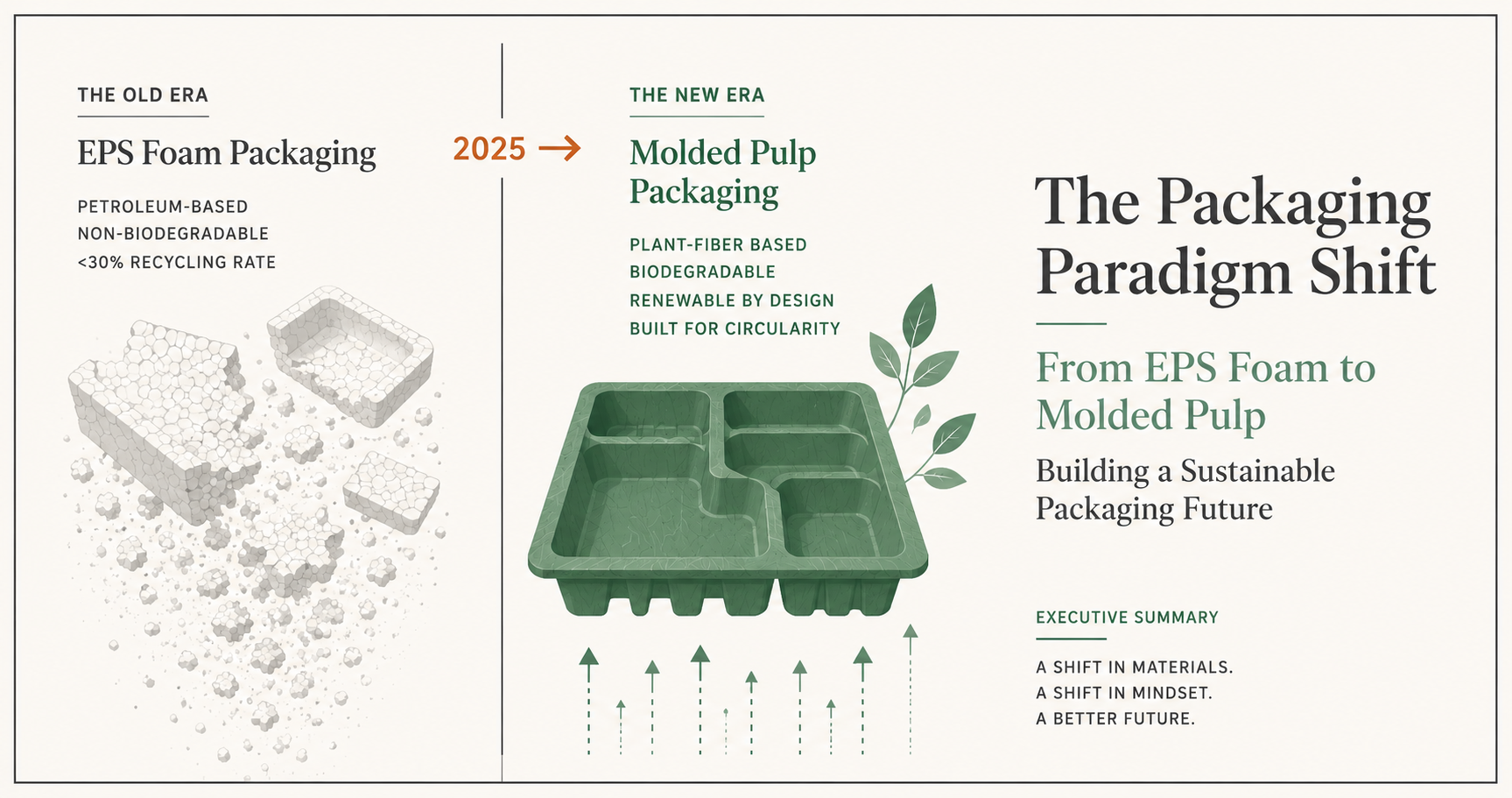
For most of the past half-century, expanded polystyrene — EPS foam — was the packaging industry's default answer to a deceptively simple question: how do you ship fragile things safely and cheaply?
The material's logic was hard to argue with. It was light enough to add negligible weight to a shipment. It was stable enough to cushion a smartphone through a turbulent last-mile delivery. It was cheap enough that no procurement manager lost sleep over the unit cost.
What the industry agreed, more or less collectively, to set aside was the other side of that ledger. EPS is derived from petroleum — a finite resource extracted at significant environmental cost. Once used, it degrades over centuries, not seasons. Its global recycling rate sits below 30%, which means the overwhelming majority of every EPS tray, corner block, and clamshell ever produced is either in a landfill, an ocean, or the atmosphere. Every year, more than ten million tonnes of EPS waste enter the environment. The material that protected products so well has become one of the most persistent pollutants in the packaging chain.
For decades, the industry absorbed this contradiction because the economic case for EPS was simply too strong. That calculus is changing — driven not by sentiment, but by regulation, supply chain risk, and a new generation of alternative materials that no longer ask brands to choose between performance and responsibility.
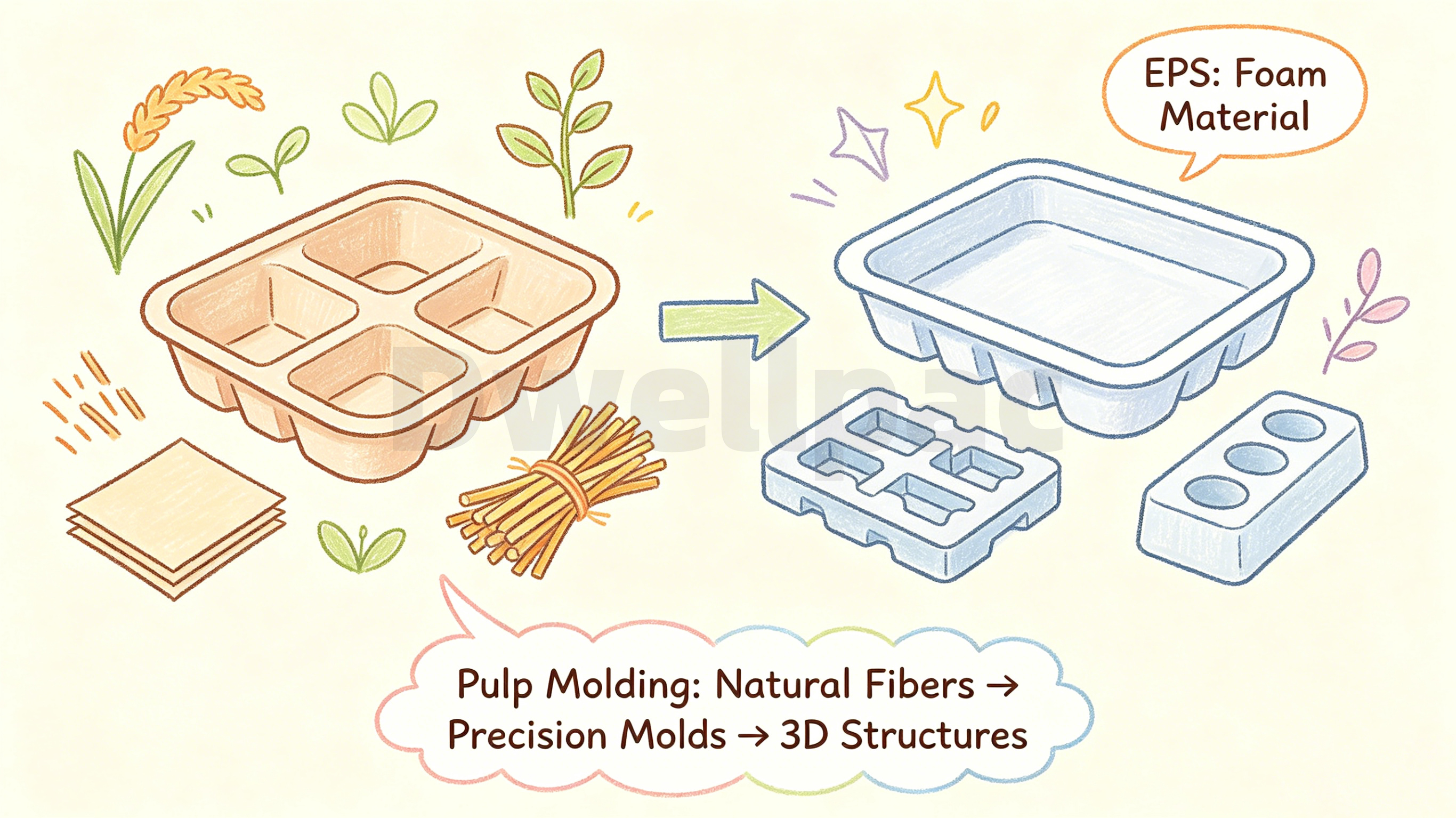
The instinct, when comparing pulp molded trays to EPS foam, is to frame the conversation around sustainability. That framing, while accurate, undersells what is actually happening at the engineering level.
Pulp molding starts with natural plant fibres — recovered paper, agricultural residues — which are processed into a slurry, formed over precision molds, and dried into three-dimensional structures that can be engineered to almost any geometry. The result is a material whose performance profile is not simply "good enough to replace EPS." In several specific dimensions, it is measurably better.
EPS begins to deform at around 80°C, which creates real risk for products moving through warm-climate logistics networks or stored in non-climate-controlled environments. Pulp molded structures handle high temperatures without losing dimensional integrity, making them a more reliable choice for electronics, cosmetics, and medical products where packaging failure during transit is not an acceptable outcome.
EPS packaging is inherently volumetric — it occupies space even when empty, which inflates warehousing costs and reduces freight efficiency. Pulp trays are designed from the outset to nest and stack, allowing the same floor area to hold significantly more units. For high-volume manufacturers, this difference compounds meaningfully across a distribution network.
EPS cannot carry high-resolution graphics without additional surface treatment. Pulp molding's smooth, seamless surface accepts full-colour printing directly, which matters enormously for premium consumer goods — beverages, cosmetics, electronics — where the unboxing experience is a deliberate part of the brand architecture. A tray that protects the product but degrades the brand moment is not a neutral outcome.
EPS faces active restrictions in dozens of markets. Pulp molded products achieve ROHS, SGS, and REACH certification with relative ease, and can be formulated with antistatic properties to meet the ESD requirements of the electronics industry — a capability that EPS requires separate processing to achieve.
| Dimension | EPS Foam | Pulp Molded Packaging |
|---|---|---|
| Raw material | Petroleum-derived polystyrene | Recovered plant fibre (paper, bagasse, agricultural residue) |
| Biodegradability | Centuries; non-biodegradable | Biodegrades in months under composting conditions |
| Global recycling rate | < 30% | Readily recyclable in standard paper streams |
| Temperature resistance | Deforms above 80°C | Stable at high temperature; no deformation |
| Stackability | Bulky; occupies volume when empty | Nestable; reduces warehouse and freight footprint |
| Surface printability | Requires additional treatment for graphics | Accepts full-colour printing directly on surface |
| ESD compliance | Requires separate antistatic processing | Formulated with antistatic properties during production |
| Regulatory status | Restricted or banned in 40+ markets | ROHS, SGS, REACH certified; compliant across markets |
Key insight: The shift from EPS to pulp molding is not a sustainability concession that sacrifices performance. In temperature resistance, stackability, print quality, and compliance, pulp molding outperforms EPS on engineering merit — not environmental appeal.
The shift from EPS to pulp molded packaging is not hypothetical or future-tense. It is happening now, sector by sector, driven by the specific engineering and commercial pressures each industry faces.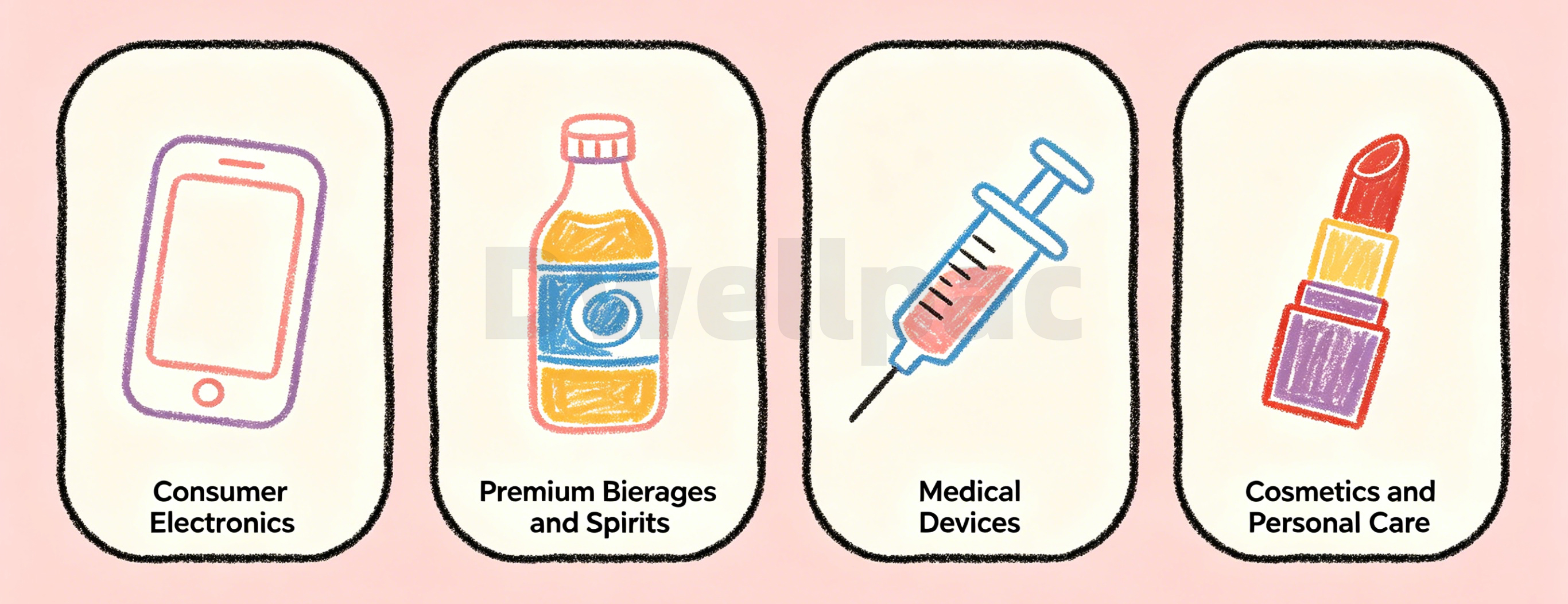
The demands are particularly exacting. A precision instrument or high-end smartphone requires packaging that eliminates movement within the carton, absorbs vibration energy across a range of frequencies, and meets ESD standards to prevent electrostatic damage. Pulp molded trays, formed over custom molds to mirror the exact contours of the product, achieve all three. The micro-porous structure of the fibre matrix absorbs vibrational energy naturally. The antistatic formulation addresses ESD without additional processing steps.
Bottle packaging must distribute impact forces evenly across multiple units, maintain structural integrity through repeated handling, and present well on the retail shelf. Pulp molded trays with contoured channels and wave-pattern designs distribute shock loads effectively. Their smooth surfaces carry brand graphics without the blurring or abrasion that corrugated alternatives introduce over a distribution cycle. For a premium product whose brand equity depends on how it looks at the point of sale, this is not a minor consideration.
Medical device packaging occupies the most demanding end of the spectrum. It must be light enough not to add logistical burden, adaptable enough to accommodate a wide range of device geometries, and protective enough to prevent any contact damage during handling. Pulp molding's formability — the ability to create precise internal cavities through custom mold design — makes it one of the few materials that can serve both a small precision instrument and a large piece of capital equipment within the same product family.
The requirements converge around structural precision and aesthetic compatibility. Glass-bottled products need packaging with reinforced walls and structural ribs to resist deformation under load. Irregular geometries — the hexagonal bottle, the curved compact — need cavities that mirror their contours exactly, eliminating the micro-movements that cause surface damage in transit. And the packaging itself must look appropriate alongside the product it protects, which rules out any solution that reads as industrial or utilitarian.
| Industry | Critical Requirement | EPS Limitation | Pulp Molding Advantage |
|---|---|---|---|
| Consumer electronics | Vibration absorption + ESD compliance | Requires separate antistatic processing | Micro-porous fibre matrix; built-in ESD formulation |
| Premium beverages | Impact distribution + brand presentation | Cannot carry graphics without treatment | Full-colour direct printing; contoured channel design |
| Medical devices | Precision cavity + regulatory compliance | Bulky; limited geometry adaptability | Custom mold cavities; ROHS/SGS/REACH certified |
| Cosmetics | Structural precision + aesthetic compatibility | Reads as industrial/utilitarian | Reinforced walls; smooth surface; premium appearance |
Understanding pulp molding's technical advantages is necessary but not sufficient. The deeper question — the one that separates companies that execute this transition successfully from those that struggle — is about mold design capability.

The performance of a pulp molded tray is not inherent to the material. It is a function of how precisely the mold has been engineered to match the product it protects. A tray designed with the right internal geometry, wall thickness distribution, and structural reinforcement at the correct points will outperform EPS significantly. A tray designed without that precision will underperform — and that underperformance will be attributed to the material rather than the engineering.
This is why the shift from EPS to pulp molding is not simply a materials procurement decision. It requires access to mold engineering expertise that can translate a product's protection requirements into a three-dimensional cavity geometry, and manufacturing capability that can hold that geometry to the tolerances required. The certification stack — ROHS, SGS, REACH, ESD compliance — follows from the design, not the other way around.
For manufacturers evaluating this transition: the material is available. The question is whether the design and tooling capability exists to extract its full performance potential. That capability is the real competitive frontier, and increasingly, it is where the decision between suppliers is made.
The regulatory environment is tightening across every major market:
| Region | Status | Key Legislation |
|---|---|---|
| European Union | Active bans in multiple member states; EU-wide single-use plastics directive in force | SUP Directive (EU) 2019/904 |
| North America | State-level bans (California, New York, Colorado, etc.); federal procurement preference for non-EPS | State-level legislation; FTC Green Guides |
| Asia-Pacific | China, India, Japan — phased bans on single-use EPS packaging; extended producer responsibility frameworks | National plastic waste reduction plans |
| Middle East & Africa | Emerging restrictions in UAE, Saudi Arabia; packaging import requirements tightening | National sustainability strategies |
The direction of travel is unambiguous. For packaging decision-makers, the question is not whether regulatory pressure on EPS will increase — it is whether their packaging specification pipeline is ready when it does.
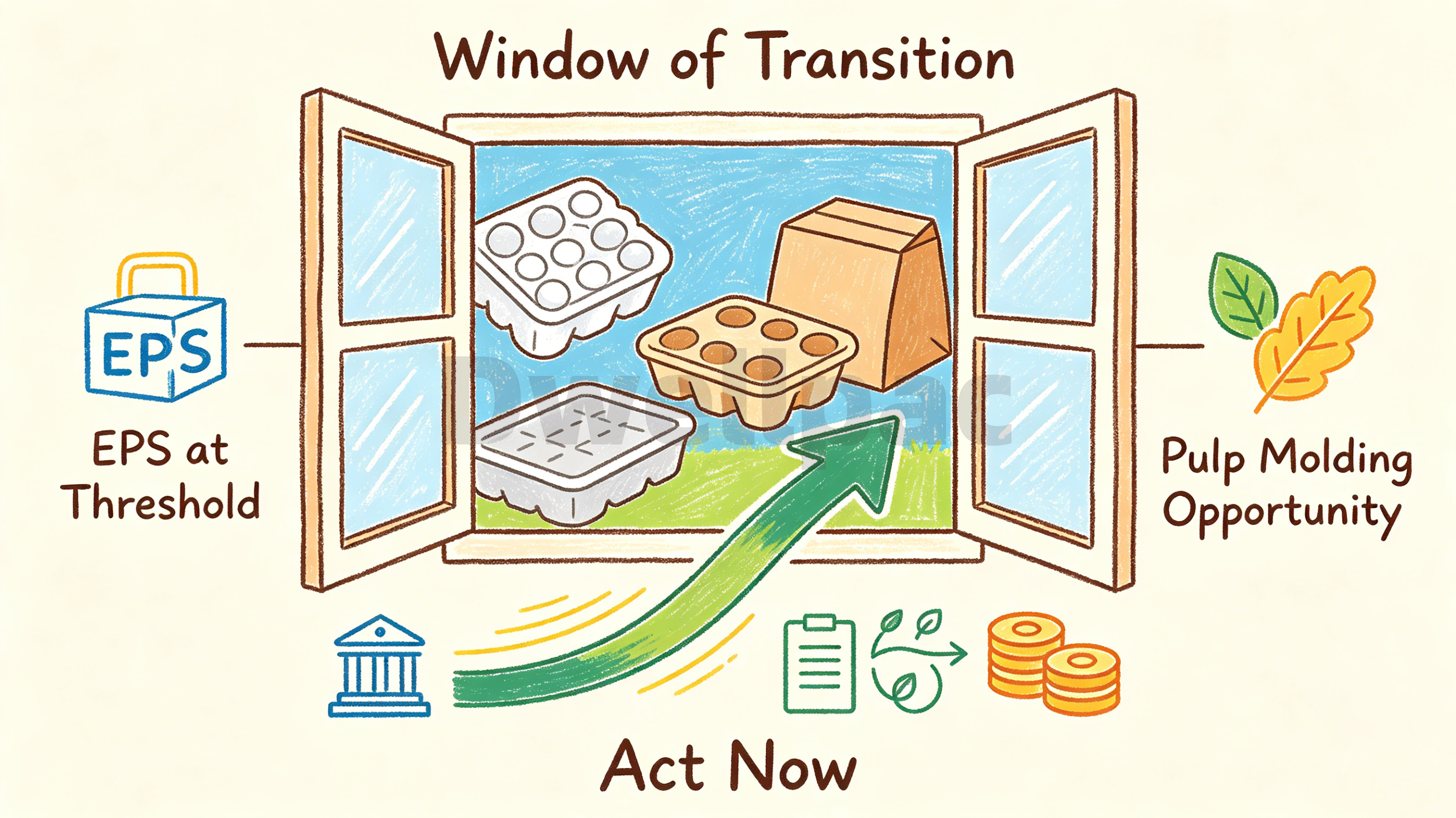
Every material transition in packaging history has followed a recognisable arc. The incumbent dominates until regulatory pressure, cost shifts, and performance alternatives reach a threshold — and then the transition accelerates faster than most incumbents expect.
EPS is at that threshold now. The regulatory environment is tightening across Europe, North America, and increasingly across Asia and the Middle East. The performance case for pulp molding has been established across multiple demanding application categories. The certification pathways are clear.
What remains is execution: identifying the right equipment configuration, investing in mold design capability, and building the certification infrastructure that opens access to premium supply chains.
The brands and manufacturers that move through this window during the transition period will find it considerably easier — and cheaper — to establish position than those who wait for the outcome to be certain. That is not a prediction. It is simply how material transitions have always worked.
Is pulp molded packaging as protective as EPS foam?
Yes — and in several dimensions, it is measurably better. Pulp molded trays, when designed with precision mold tooling, provide equivalent or superior vibration absorption, temperature resistance, and structural integrity. The key variable is mold design quality, not the material itself. A well-engineered pulp tray will outperform EPS; a poorly engineered one will not.
What certifications can pulp molded packaging achieve?
Pulp molded products readily achieve ROHS, SGS, and REACH compliance. For electronics applications, antistatic properties can be formulated directly into the fibre matrix to meet ESD requirements — no additional processing steps needed. For food-contact applications, food-grade formulations are available that comply with FDA and EU food-contact material regulations.
How does the cost of pulp molded packaging compare to EPS?
Unit-for-unit, pulp molded trays can carry a slight premium over EPS on raw material cost. However, total landed cost analysis typically favours pulp molding when stacking efficiency (freight reduction), regulatory compliance cost avoidance, and brand premium from superior presentation are factored in. For high-volume applications, the cost gap narrows significantly as mold amortization spreads across larger production runs.
What is the minimum production volume for switching to pulp molded packaging?
The primary investment is in mold tooling — not in the base material or equipment. For a single custom mold, minimum viable volumes typically start around 50,000–100,000 units per year. Dwellpac works with manufacturers to assess whether their product mix and volume profile justify the transition, and can recommend equipment configurations scaled to your output requirements.
How long does it take to transition from EPS to pulp molded packaging?
For a manufacturer with an established product line, a typical transition timeline is: mold design and sampling (4–8 weeks), production trials and certification (2–4 weeks), and ramp-up to full production volume (4–8 weeks). Total timeline: approximately 10–20 weeks from design freeze to full output. The critical path item is almost always mold design — not equipment lead time.
Can Dwellpac support the full transition from EPS to pulp molding?
Yes. Dwellpac engineers and manufactures pulp molding equipment for producers transitioning away from EPS across electronics, cosmetics, beverage, and medical packaging. Our team supports the full chain — equipment configuration, mold design consultation, certification guidance, and production ramp-up. Contact us to discuss your specific application.
Dwellpac engineers and manufactures pulp molding equipment for producers transitioning away from EPS across electronics, cosmetics, beverage, and medical packaging. If you are evaluating equipment configuration, mold design capability, or certification pathways for this transition, our engineering team is available to discuss your specific application — with a preliminary feasibility assessment within 48 hours.
Request a Transition Assessment Browse equipment collection →


