Introduction: Forming, hot-pressing, and trimming are three linked stages in a pulp tableware line, and clear boundaries prevent basic process confusion.
For category learners, the useful question is not whether these steps exist, but how each one changes the workpiece, the workflow, and the meaning of the terms themselves. In molded pulp tableware production, these stages are often discussed together because they appear in one line, yet they are not interchangeable. Once you separate their roles, it becomes easier to read equipment descriptions, compare line layouts, and understand why wet-form prepress or auto trimming matters without treating them as standalone claims.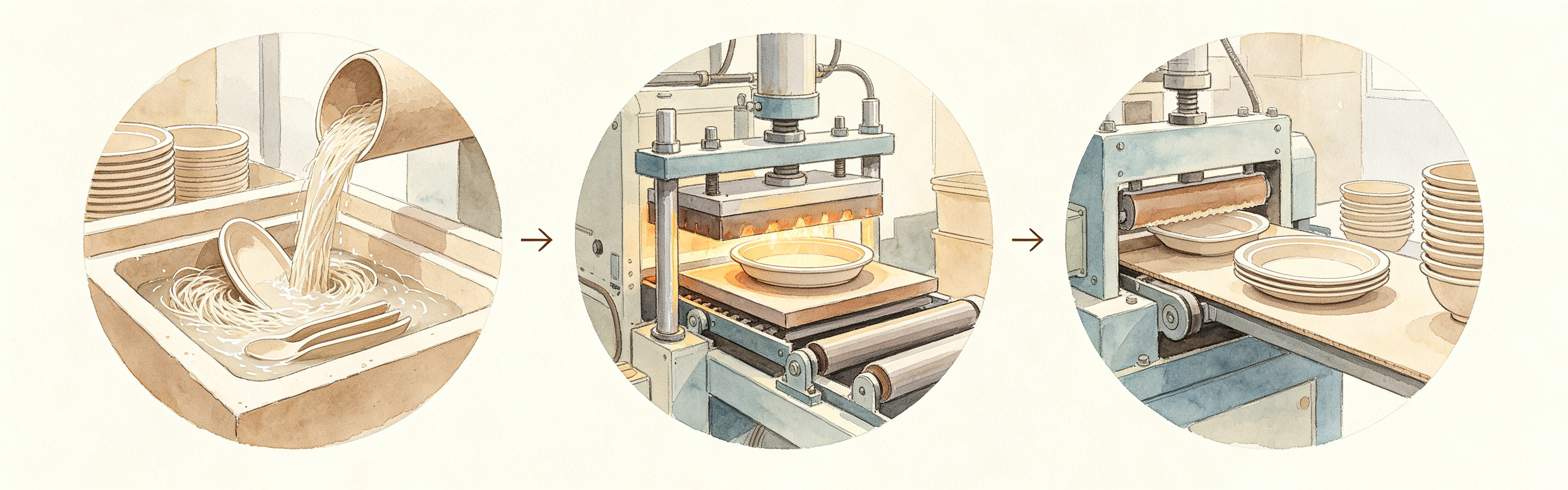
The main source of confusion is that forming, hot-pressing, and trimming are all real processing actions, but each answers a different production problem. Forming creates the wet shape from pulp. Hot-pressing changes the formed piece under heat and pressure so the shape becomes more stable and the surface more finished. Trimming removes edge excess and refines the outline. If you describe them separately, the line can sound like three unrelated machines. In practice, they are consecutive responses to a single material journey, and the boundary between them is what lets a reader understand the production logic rather than just memorize labels. That process-chain view matters because a pulp tableware line is judged by transitions, not by isolated modules. The forming stage sets the rough geometry, but it does not finish the part. Hot-pressing does not invent a new shape; it locks in and improves the one that already exists. Trimming does not change the structural intent of the item; it finalizes the edge and removes what remains from the earlier stages. This is why equipment discussions often combine these terms. They describe one sequence with three functions, not three products competing for the same job. For a learner reading about molded fiber tableware, the safest method is to follow the workpiece forward: first ask how the pulp becomes a wet part, then how that part is pressed into a more controlled state, and only then how the edge is cleaned and separated from trim waste. The chain also protects readers from overvaluing a single visible station. A hot-press unit may look more dramatic because it involves heat and pressure, while a trimming unit may look more precise because it defines the final outline. Neither meaning cancels the forming step. The early distribution of wet fiber still influences what later pressing can stabilize, and later trimming can only remove unwanted edge material rather than rebuild the main body. Seeing the three steps together therefore creates a better conceptual boundary than treating each label as a separate feature claim.
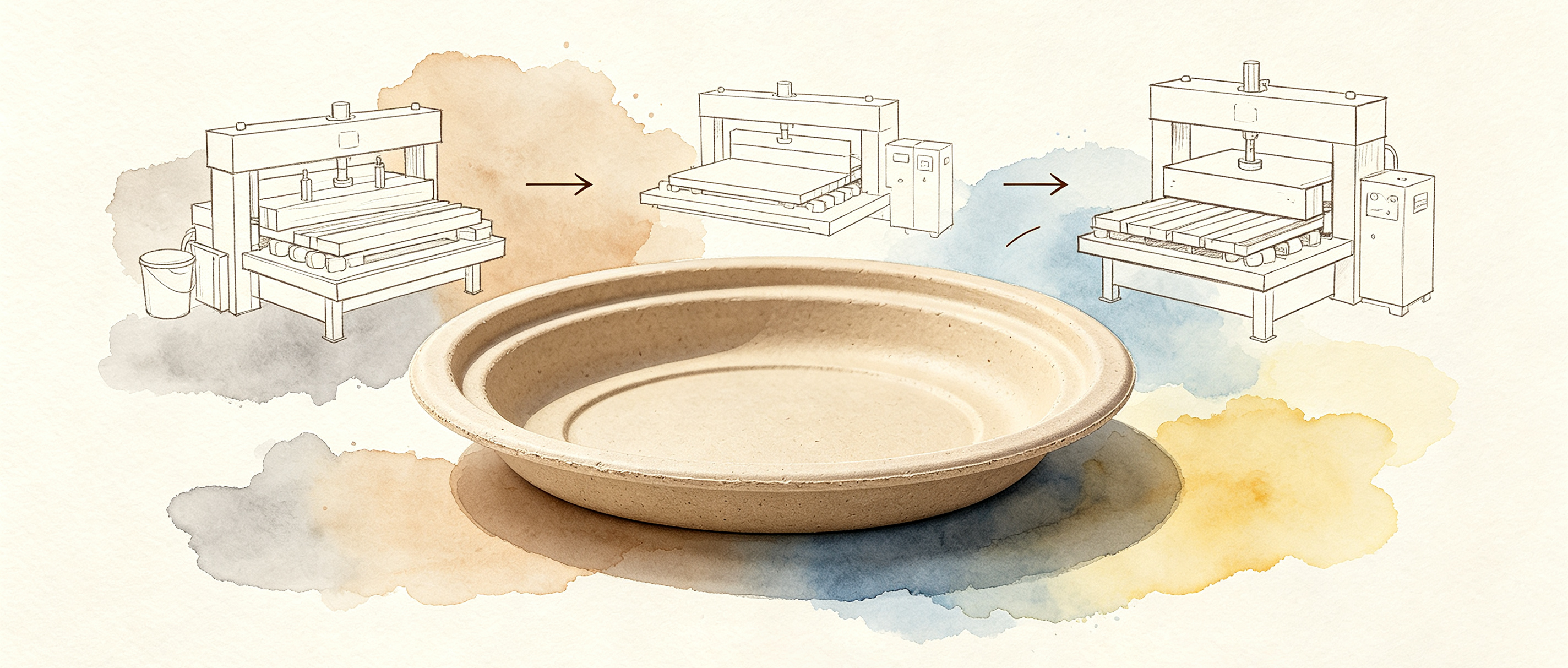
Forming is the stage where the pulp begins to become a recognizable tableware shape. At this point, the important issue is not cosmetic smoothness but whether the wet mass is distributed in a way that can support the intended item geometry. A forming stage may use hydraulic drive and wet-form prepress in some configurations, but the concept boundary stays the same: the role of forming is to establish the part before it is hardened or finished. In a pulp tableware machine, that means the formed item still needs later steps to reach a usable production state. Hot-pressing serves a different purpose. It is the stage where the formed piece is compressed under heat and pressure so the surface and structure become more controlled. In the Dwellpac pulp tableware line, hot-pressing is one of the core modules, with a 400 kN hotpress pressure specification referenced for the line. That number is useful as a configuration signal, but it should not be read as a universal performance promise. The conceptual point is simpler: hot-pressing is where the line moves from wet shape to a more finished, denser, and more stable part. If forming answers "what shape is being created," hot-pressing answers "how is that shape set and refined."
Readers sometimes treat hot-pressing as if it were a separate product-design decision, but it is better understood as a stabilization step inside the same workflow. It does not replace forming, and it does not perform the edge cleanup associated with trimming. Its purpose is to take the rough formed item and make the geometry more consistent. That distinction matters especially in molded pulp tableware, where terminology can blur if a line is described only by the most visible machine names. When hot-pressing is discussed properly, it is about structure and finish, not about changing the product category itself.
Trimming comes after the part has already been formed and hot-pressed. Its job is to clean the perimeter, not to create the body of the item from scratch. That is why trimming belongs to the finishing side of the chain even when it is integrated into the same production line. The Dwellpac line includes T2 auto trimming and cuttings separation, which shows trimming as a distinct finishing operation with its own handling logic. The important boundary is that trimming does not define the main cavity shape or the heat-set surface; it resolves leftover edges and separates the waste generated there. This is also why trimming pressure, such as the 600 kN trimming pressure referenced for the Dwellpac line, should be read in its own stage context rather than confused with hotpress pressure.
Wet-form prepress sits before hot-pressing, which is why it is easy to misunderstand if you only look at machine names. Its role is to prepare the wet formed piece so the next stage starts from a more controlled condition. In practical terms, that means the prepress step changes the starting point before heat and pressure do their work. In the Dwellpac line, F2 wet-form prepress is associated with improving dryness and supporting shape and structural integrity. That is a useful boundary to keep in mind: prepress is not the same as final hot-pressing, and it is not trimming in disguise. It is an upstream adjustment that makes the later hot-pressing stage more meaningful. Auto trimming belongs after forming and hot-pressing because its function is to automate the finishing side of the chain. It does not redefine the forming stage, and it does not change the meaning of wet-form prepress. What it does change is how the line handles edge finishing and transfer. In the product context, auto trimming is paired with outfeed handling, and cuttings separation is included so the trim waste can be isolated from finished parts. That is why auto trimming should be read as a finishing-stage feature. It improves the workflow around the part, but it does not alter the core logic of how the part is first shaped. A useful way to read the full chain is to ask which question each module answers. Forming answers how the pulp becomes a part. Wet-form prepress answers how that wet part is prepared for heat and pressure. Hot-pressing answers how the part is stabilized and finished at the surface and structure level. Auto trimming answers how the edges are finalized and handled after the main shape is already there. When those answers stay separate, the line becomes easier to understand, and equipment descriptions become less misleading. The same clarity also helps when comparing a basic line to one that integrates a robot or a high-speed trimming unit, because the extra automation does not change the core terminology. A Dwellpac pulp tableware line provides a concrete example of this boundary-aware language. It places forming, hot-pressing, trimming, wet-form prepress, hydraulic forming, cuttings separation, and auto trimming in one configuration, which reflects how actual pulp tableware lines are usually discussed: as a chain with connected stages. It also shows that a line can include a 980 x 980 mm platen size, a variable 18-40 second cycle time, and robot pairing, but those details sit beside the process terms rather than replacing them. For a category learner, that is the real lesson. The terms are not interchangeable labels for one machine feature; they are a sequence. Understanding that sequence is more valuable than memorizing a parameter before knowing which stage the parameter belongs to.
Forming, hot-pressing, and trimming are best understood as a single process chain with three different jobs. Forming creates the wet shape, hot-pressing stabilizes and finishes that shape, and trimming resolves the edge boundary after the main part is already made. Once you see the sequence clearly, it becomes easier to read pulp tableware machine descriptions, understand where wet-form prepress belongs, and avoid treating auto trimming as part of the forming stage. The Dwellpac line offers a concrete example of that chain-based language without changing the underlying terminology. For readers comparing process layouts, the useful next step is to keep the stage boundaries clear and then judge how each module is configured.
Q:How are forming, hot-pressing, and trimming different in a pulp tableware line?
A:Forming creates the initial wet tableware shape from pulp, hot-pressing sets and refines that shape under heat and pressure, and trimming removes edge excess after the main body has already been made. They are consecutive stages, not interchangeable names for the same step.
Q:What role does wet-form prepress play before hot pressing?
A:Wet-form prepress prepares the formed pulp piece for the next stage by improving its starting condition before hot-pressing acts on it. In process terms, it sits upstream of the final press and helps the line move from a wetter, less stable form toward a more controlled one.
Q:Does auto trimming change the forming stage or only the finishing stage?
A:Auto trimming belongs to the finishing stage. It does not change how the part is formed, and it does not alter the meaning of hot-pressing. Its role is to automate edge cleanup and related transfer handling after the core shape has already been established.
Technical Association of the Pulp & Paper Industry Inc.
Paper and Paperboard: Material-Specific Data | US EPA
Dwellpac Pulp Tableware Line | Aluminum mold, suitable for pulp molding, Model DW-AFR-9898-F2H2T2


